

WEEK OF NOVEMBER 29 THROUGH DECEMBER 4
Israel Nearing EU Trade Partnership Status? Dec. 3….(Jerusalem Post) Israel is only a word or two away from reaching an agreement with the EU that will give it many of the same rights afforded member states within the European Union. "We are close to concluding this chapter in the action plan. It's just a question of one or two words," said EU President Bernard Bot, who is also the Dutch foreign minister. According to a Foreign Ministry spokesman there is only a small section of text, dealing with weapons of mass destruction in the region, that hasn't been agreed upon. "It's up to Israel to make one little step and we will make a major step in accommodating the Israelis," Bot said at a two-day Euro-Mediterranean Partnership conference. The program, known as the European Neighborhood policy, offers free access to goods, services, people and capital to countries outside the European Union in exchange for economic and political reform. Other countries slated to attain this status are Moldova, Ukraine, Jordan, Morocco, Tunisia and the Palestinian Authority. The Netherlands on Monday agreed to outlaw Hizbullah, adding it hoped its EU partners will follow suit. Bot announced the step at a meeting with Foreign Minister Silvan Shalom. Shalom welcomed the Dutch move and urged the other EU nations "to place Hizbullah on the European list of terrorist organization." He called Iran-backed Hizbullah "one of the leading forces threatening the effort to bring stability and calm to the Palestinian Authority." The EU so far has not agreed to this proposal, although Bot has submitted a request that it do so. Both the EU and Israel spoke of the good relations between them. "I do not accept the formula that Israel can live without Europe and Europe can live without Israel," said Shalom. "Israel and Europe share deep-rooted values, the close relationship between us is a strategic asset to both sides," said Shalom. Still, he said, "I would like to see the Europeans have a more balanced attitude toward the conflict." Bot said he didn't understand Shalom's statement. "We have been very balanced in our approach," he said. The EU chief policy adviser on foreign affairs, Javier Solana, said, "we will play a role in the Mid-east whether our good friend Shalom likes it or not." FOJ Note: The one little step that Europe requires Israel to take, is to vacate the West Bank and cooperate in the Roadmap Peace Plan to accommodate a new Palestinian Sate.
Syria to Join EU Trade Group, Despite WMD Concerns Dec. 3….(World tribune) The European Union is preparing to welcome Syria as a member of the Mediterranean Partnership. EU officials said European ministers planned to meet their counterparts from Middle East states today to welcome the participation of Syria as a member of the Association Agreement. The agreement would allow for trade and other benefits by Brussels to Damascus. Syria was the last of nine Mediterranean states that concluded negotiations with the EU for entry into the Association Agreement, Middle East Newsline reported. The negotiations were hampered by a demand by Britain, France and Germany for the regime of President Bashar Assad to guarantee the end of Syria's weapons of mass destruction program. In October, the EU reported that Brussels and Damascus reached an agreement that resulted in the conclusion of negotiations. The EU did not elaborate, but diplomats said Damascus did not pledge to dismantle its biological or chemical weapons programs. On Nov. 29, the Euro-Mediterranean Ministers for Foreign Affairs were scheduled to meet in The Hague to commemorate the 10th anniversary of their partnership, dubbed the "Barcelona Process." Officials said a key issue on the agenda would be the conclusion of talks with Syria for entry into the Association Agreement. "The meeting will focus on three themes: a review of the process and its future direction; economic reforms and investment; and social-cultural aspects," an EU statement said on Nov. 26. "Ministers will welcome the conclusion of negotiations with Syria for an Association Agreement with the EU, which completes the grid of agreements with the EU's Mediterranean Partners." The EU said it planned to grant $937 million to Middle East states in 2004 in an effort to promote peace, particularly between Israel and the Palestinians. The EU ministers were expected to discuss the aid with PA International Cooperation Minister Nabil Shaath and Israeli Foreign Minister Silvan Shalom. "With the conclusion of negotiations with Syria [October 2004], the grid of Association Agreements with Mediterranean Partners has been completed," the EU statement said. "Association Agreements are in force between the EU and Tunisia, Morocco, Jordan, Egypt and on an interim basis with the Palestinian Authority. Agreements were signed with Algeria in December 2001, and with Lebanon in January 2002."
Fatah´s Farouk Kadumi: "Two States" Just a Temporary Solution Dec. 3….(Arutz) A top PA official has reiterated the end-goal of the creation of a Palestinian state alongside Israel: a Palestinian state instead of Israel. In a seeming re-affirmation of the PLO's 1974 "destroy Israel" program, commonly known as the Phased Plan, Fatah co-founder Farouk Kadumi termed the struggle for a two-state solution just a “stage” on the road to “only one state.” Kadumi spoke on Nov. 29th with Iran’s Al-Aram television station. When the interviewer asked Kadumi, “What is the future of Palestine?” the PLO leader answered: “At this stage there will be two states. Many years from now there will be only one.” Asked why he has not softened his stance against Israel’s existence, Kadumi replied, "Our enemy always says, 'This is Judea and Samaria.' They haven't changed their discourse. If they change theirs, we will change ours, and if not, we will keep saying that armed resistance is the way to Palestine." He expressed confidence in the Arabs' ultimate victory, saying, “There are 300 million Arabs, while Israel has only the sea behind it.” The basic principle of the 1974 PLO Phased Plan is that the PLO would struggle to initially establish an "independent combatant national authority" over any territory "liberated" from Israeli rule. That “national authority” would then be used as a base for continued terror attacks. The final phase of the plan is all-out war against Israel by all her Arab neighbors with the hope of destroying the Jewish State entirely.
Iran Endorses 200 Suicide Bombers for Attacks against Americans, Israelis Dec. 3….(Canadian Press) Some 200 masked young men and women gathered at a Tehran cemetery Thursday to pledge their willingness to carry out suicide bomb attacks against Americans in Iraq and Israelis. The ceremony was organized by the Headquarters for Commemorating Martyrs of the Global Islamic Movement, a shadowy group that has since June been seeking volunteers for attacks in Iraq and Israel. A spokesman, Ali Mohammadi, described Thursday's group as Iran’s "first suicide commando unit," though another official has claimed members already have carried out attacks in Israel. "Sooner or later we will bury all blasphemous occupiers of Islamic lands," Mohammadi said. The group has the backing of some prominent hard-line Iranian politicians. Iran has had no diplomatic ties with the United States since the 1979 Islamic revolution ousted the U.S.-backed shah. Iran portrays Israel as its main nemesis and backs anti-Israeli groups like Lebanon's Hezbollah. Wives, husbands and children accompanied volunteers to the cemetery, which was decorated with posters denouncing America and Israel. "I joined the unit to fulfill my religious task for Palestine," said a volunteer who gave only his age, 23. Thursday's ceremony included the unveiling of two-meter (6-foot) stone column commemorating a 1983 attack on US Marine barracks in Lebanon as "the biggest suicide bombing operation against global blasphemy." In the early hours of Oct. 23, 1983, a truck carrying more than 2,000 pounds of explosives sped past a sentry post and exploded in the center of the barracks, killing 241 Marines. Then US President Ronald Reagan, under pressure from the State Department ordered US troops to withdraw from Lebanon a few months after the bombing.
Ariel Sharon’s Government Near Collapse Dec. 3….(David Dolan) Prime Minister Ariel Sharon may be near the end of his time as Israel’s leader, after firing five Cabinet ministers from the Shinui party, his biggest coalition partner, after it voted against the state budget. The move signals the collapse of Sharon's coalition, though he can possibly save it by forming an alliance with the dovish Labor party. Shinui's departure leaves Sharon with an extremely weak government, just 40 seats in the 120-member Knesset (parliament). The anti-religious Shinui quit over Sharon's allocation of $64 million to the ultra-Orthodox United Torah Judaism party, effectively a buyoff for the party's support of the Gaza withdrawal plan. But Labor's 22 seats would give Sharon a slim majority. If Sharon fails to bring Labor into the coalition, he will be forced to call early elections and the Gaza pullout would be put off. My best guess tonight is that Sharon is on his way out as Israel's leader, along with his controversial disengagement plan. Although the veteran politician may succeed in forming a new "national unity" government with Labor (Shimon Peres) and the small Torah Judaism party, the fact still remains that around half of his own Likud legislators believe that the premier's withdrawal plan is a severe mistake that will only encourage further Palestinian terror and produce civil strife amongst Israel's divided Jews. Peres and Labor, which strongly supports getting out of Gaza, may try to bail Sharon out, but it will cost Sharon a heavy price.
Palestinian Election Rumblings Dec. 3….(David Dolan) Fresh storm clouds are forming on the Palestinian side of the equation as the Palestinian campaign begins to find a formal successor to Arafat by ext month. Tanzim terrorist leader Marwan Barghouti; the main architect of the current violent attrition war that has raged since late 2000; filed as an election candidate today after promising last week to back interim PLO chief Mahmoud Abbas. Analysts say the surprise move may provoke Barghouti's armed Fatah thugs to wage a violent campaign on his behalf, with likely dire consequences for all, including the frozen "land for peace" process. Israel has made clear it will not release Barghouti from prison even if he is elected pope, given that he was only recently convicted for ordering Tanzim terror attacks that left four Israelis and a Greek priest dead in recent years. In another sign of brewing chaos ahead on the Palestinian street, the extremist Hamas movement announced today that it will boycott the January 9th vote because the position of Palestinian Authority leader emanated from the despised Oslo peace accords. Some analysts believe that Hamas received orders to boycott the election from Iran, via its Hizbullah proxy force. They say the fundamentalist regime in Tehran; busy developing nuclear weapons while pretending not to; is seeking to thwart both the Palestinian and Iraqi elections scheduled for January in an attempt to keep the regional anti-Israel/US/UK jihad war boiling.
Iranian Scientist: Saudis Have Nukes Too Dec. 3….(FOJ) Iran believes Saudi Arabia is a nuclear state. Iranian sources said the Teheran regime has concluded that the Saudi kingdom has acquired access to nuclear weapons and technology. The sources said Saudi Arabia signed an agreement in 2003 with Pakistan for the latter to help the Arab kingdom in both the deployment of nuclear weapons and missile delivery systems. A leading Iranian scientist and member of the nation's nuclear community has reported that Saudi Arabia joined the world's nuclear club. Teheran University Professor Abu Mohammad Asgarkhani said in an address on Nov. 9 that Iran required a nuclear weapon after Pakistan and Saudi Arabia acquired atomic weapons. In his address, Asgarkhani said the world has been divided into nuclear and non-nuclear powers, or the "haves," and the "have-nots." He said Iran was in the latter category. In 1998, Pakistan tested nuclear weapons. Saudi Arabia, however, has denied having any nuclear weapons or nuclear energy program. The speech marked a rare Iranian statement that sought to justify Teheran's need for nuclear weapons and came after its pledge not to embark on such a program.
*Grim Choices on the Nuclear Front FOJ Note : Folks, this article by William Rusher is a must read on the subject of the ever burdensome problem of the proliferation of nuclear weapons. Jesus alluded to the “distress of nations” in the Last Days, and the issue of WMD is of grave concern to many nations. Nations around the world are anguished over the prospect of the nuclear threat, especially in our day when terrorism is such a worrisome component. As we watch Iran, and other rogue states acquire this technology, we must be ever mindful of the prophesied coming of the Day of the Lord, when the world will witness a time of trouble beyond anything the world has ever seen before! And, ironically it all centers around the burdensome dilemma of Israel!Dec. 3….(William Rusher) Ever since the United States emerged from World War II as the sole possessor of nuclear weapons, it has been American policy to prevent other nations from acquiring them. Little could be done, however, to keep such large and technologically advanced countries as the Soviet Union, Britain, France and China from developing them, and soon these five became the original members of the "nuclear club." Fortunately, for all their differences, all five were responsible enough not to brandish these weapons recklessly, and they also shared a common interest in not wanting other nations to acquire nuclear capability. Thus was born the Nuclear Nonproliferation Treaty, under which signatories pledged not to develop nuclear weapons, and which has been the basic instrument of American policy on this issue ever since. Under it, a good many countries; some, but not all, friendly to the United States and the West; have taken the pledge and, by and large, abided by it. One notable early exception was Israel, which refused to sign the treaty, though it has never admitted developing nuclear weapons. It is well known, however, that Israel possesses them; a fact tempered by the reflection that it almost certainly would use them only if threatened with extinction by its Arab neighbors. Over the decades, however, nuclear technology has inevitably spread, in varying degrees, to upward of 20 to 30 nations; some of which have signed the Nuclear Nonproliferation Treaty, others haven't. The bad news is that the world has now arrived at a point where several of these nations are capable of building nuclear bombs, and a few have actually done so. India and Pakistan, to take the most glaring examples, have both joined the nuclear club, as just one more step in their bitter rivalry. Worse yet, two of the nations that are believed to have developed nuclear weapons, or to be on the verge of doing so, are aptly described as "rogue states"; relatively small but ugly despotisms that may well use them if they don't get their way: Iran and North Korea. The problem has been foreseeable for many years, and has gotten steadily worse. The last president who could afford to stall; Bill Clinton; stalled right through his two terms, and left this miserable dilemma on the doorstep of his successor, George W. Bush, who no longer has the luxury of stalling. Are we going to let Iran and North Korea join the nuclear club, with all that that implies, or not? North Korea, a leftover communist tyranny, is an economic basket case that might ordinarily be left to collapse in its own sweet time. But its "Dear Leader," Kim Jong-Il, has survived by selling his nuclear know-how to other countries, as well as by blackmailing the world to give him aid in return for not using his nukes or building more of them. Putting Kim out of business would require aerial strikes on his nuclear installations, but he warns that, if that happens, he has the will and the ability to kill hundreds of thousands of people in South Korea or Japan first, with the bombs he has on hand. Iran is believed to be within a year or two of having nuclear weapons, which it would probably aim at Israel as a contribution to the Arab cause. That, to be sure, gives Israel a good reason to launch aerial attacks on Iran's nuclear facilities (if they can be found), as it did to Iraq's two decades ago. But this might well precipitate an Iranian military invasion of Iraq, where America's forces have their hands full already. What, then, is Bush to do? Getting into another war with either North Korea or Iran is probably not Karl Rove's favorite idea for enhancing Bush's popularity. But the alternative may be to see these two rogue states take their seats in the nuclear club and spend the next couple of decades blackmailing us for anything that strikes their fancy. If you have suggestions, the White House would no doubt welcome it. Al-Qaeda Statements Increasingly Focused On Israel Dec. 2….(Arutz) Recent statements by Al-Qaeda chief
Osama Bin Laden and one of his top deputies seem to indicate an apparent shift
in the global terror group’s main objectives. Recent communications from Al-Qaeda
show an intensified focus upon Israel, with attempts to scare the American
public into abandoning its support of the Jewish State having become a
recurring theme. Osama Bin Laden released a statement last month addressing the
American public prior to the US elections. Though excerpts of the statement
appeared in the Western press, the full text was not widely publicized for fear
that it included coded messages to operatives. The following are excerpts of Bin
Laden's October 29th statement, translated by MEMRI: "O American people, I
address these words to you regarding the best way of avoiding another Manhattan,
and regarding the war, its causes and its consequences, Bin Laden said. "I say
to you, as Allah is my witness: We had not considered attacking the towers, but
things reached the breaking point when we witnessed the iniquity and tyranny
of the American-Israeli coalition against our people in Palestine and Lebanon,
then I got this idea. The Al-Qaeda chief went on to explain how American support
for Israel directly led to his murder of Americans: "The events that had a
direct influence on me occurred in 1982, and the subsequent events, when the US
permitted the Israelis to invade Lebanon with the aid of the American 6th Fleet.
They started shelling, and many were killed and wounded, while others were
terrorized into fleeing. In those critical moments, I was overwhelmed by ideas
that are hard to describe, but they awakened a powerful impulse to reject
injustice and gave birth to a firm resolve to punish the oppressors. "As I was
looking at those destroyed towers in Lebanon, I was struck by the idea of
punishing the oppressor in the same manner and destroying towers in the US, to
give it a taste of what we have tasted and to deter it from killing our children
and women. On February 11, 2003, Bin Laden released a vehemently anti-Israel
statement to Al-Jazeera: We are following up with great interest and extreme
concern the crusaders' preparations for war to occupy a former capital of Islam,
loot Muslim wealth, and install an agent government, which would be a satellite
for its masters in Washington and Tel Aviv, just like all the other treasonous
and agent Arab governments. This would be in preparation for establishing the
Greater Israel. FOJ Note: Focus on Jerusalem Prophecy Ministry has been forewarning its readers for 9 years that the Muslim terrorists were targeting America because of our nation’s traditional support for Israel. The reference to a crime committed 87 years ago is a reference to the Balfour Declaration of 1917, which committed Great Britain (and later the US) to the establishment of a homeland for Jews in Palestine. Iran Boasts Victory over US, Warns Nuclear Freeze is Temporary Dec. 1….(AFP) Iran boasted it had humiliated the United States at a board meeting of the UN atomic watchdog by agreeing to what it reiterated was only a temporary freeze of its suspect nuclear program. The Iranian Islamic republic has not renounced the nuclear fuel cycle, will never renounce it and will use it," top national security official and nuclear negotiator Hassan Rowhani told a news conference. "We have proved that, in an international institution, we are capable of isolating the United States. And that is a great victory," he added. On Monday the International Atomic Energy Agency (IAEA) spared Iran the fate of being referred to the UN Security Council for possible sanctions after Tehran agreed in a deal with Britain, France and Germany to suspend its uranium enrichment program. He also asserted that Iran had only agreed to the suspension for the duration of negotiations with the European trio that should yield lucrative incentives for the Islamic republic. Iran and the European trio are to begin talks in December on a package of rewards to Iran for suspending enrichment, the key process using centrifuges to make fuel for nuclear reactors, or the explosive core of atomic bombs. Europe is ready to negotiate on trade, transfers of peaceful nuclear technology and help on security issues. But the talks will also be aimed at producing "objective guarantees" that Iran will not divert its nuclear program towards making an atomic bomb. Enrichment remains at the heart of the stand-off at the IAEA. Iran says it only wants to enrich uranium to low levels, so as to produce fuel for a series of atomic power stations designed to free up its huge oil and gas resources for export. And it zealously guards its "right" under the nuclear Non-Proliferation Treaty (NPT) to have a peaceful nuclear program, including the full fuel cycle. But there are fears that Iran's fuel cycle drive belies an effort to acquire the "strategic option" to build a bomb if circumstances dictate it. The United States insists the country already has a covert weapons plan.
UN Proposes Security Council Shake-up Dec. 1….(World Net Daily) The United Nations last night tried to overcome the bitter divisions over the war in Iraq by unveiling the most sweeping plans for reform in almost six decades, including an enlarged Security Council and guidelines for military intervention. A panel of 16 "wise men" challenged America's claim to have a right unilaterally to take "preventive" military action against looming threats. "There is little evident international acceptance of the idea of security being best preserved by a balance of power or by any single, even benignly motivated, superpower," said the panel. "The yearning for an international system governed by the rule of law has grown. No state, no matter how powerful, can by its own efforts alone make itself invulnerable to today's threats." The members of the High Level Panel on Threats, Challenges and Change include the former United States national security adviser, Brent Scowcroft, the former British ambassador to the UN, Sir David Hannay, and Yevgeny Primakov, the former Russian Prime Minister. They said that countries already had the right to take "pre-emptive" action against an "imminent" threat. But they insisted that only the Security Council should authorize "preventive" force to deal with more distant threats, such as the risk of a country obtaining a nuclear weapon. At the same time, they advocate a more robust approach by the council to stop threats from emerging, rather than trying to merely manage crises. This should include adopting the interventionist doctrine that the world has a "responsibility to protect" populations if threatened with genocide, mass killings or ethnic cleansing. The authors identified five dangers: poverty, diseases and environmental degradation; conflicts between and within states; weapons of mass destruction; terrorism; and international organized crime. The report set out five criteria for authorizing military action. These include considering the seriousness of the threat, making sure the purpose of military action is really to avert the threat, ensuring that force is used as a last resort, using only "proportional means", and weighing up the "balance of consequences" of military action. The authors say that the Security Council needs to become more representative of the modern world to ensure its "effectiveness and credibility". Every attempt to reform it over the decades has ended in failure, and the authors themselves were split on how it should be expanded. They set out two different models to enlarge the council from its current 15 members to a maximum of 24. The problem is that reforming the council would require a two-thirds majority in the General Assembly to amend the charter, which would be difficult to secure because of opposition from countries that feel left out. Already, Italy is resisting Germany's bid for a permanent seat on the council, Pakistan objects to India becoming a permanent member, Mexico and Argentina object of Brazil's ambitions, while China is suspicious of Japan's possible entry. California School Bans History Materials Referring to God Nov. 30….(MSNBC) A California teacher has been barred by his school from giving students documents from American history that refer to God, including the Declaration of Independence. Steven Williams, a fifth-grade teacher at Stevens Creek School in the San Francisco Bay Area suburb of Cupertino, sued for discrimination on Monday, claiming he had been singled out for censorship by principal Patricia Vidmar because he is a Christian. "It's a fact of American history that our founders were religious men, and to hide this fact from young fifth-graders in the name of political correctness is outrageous and shameful," said Williams' attorney, Terry Thompson. "Williams wants to teach his students the true history of our country," he said. "There is nothing in the Establishment Clause (of the US Constitution) that prohibits a teacher from showing students the Declaration of Independence." Vidmar could not be reached for comment on the lawsuit, which was filed on Monday in US District Court in San Jose and claims violations of Williams’ rights to free speech under the First Amendment. Phyllis Vogel, assistant superintendent for Cupertino Unified School District, said the lawsuit had been forwarded to a staff attorney. She declined to comment further. Mr. Williams asserts in the lawsuit that since May he has been required to submit all of his lesson plans and supplemental handouts to Vidmar for approval, and that the principal will not permit him to use any that contain references to God or Christianity. Among the materials she has rejected, according to Williams, are excerpts from the Declaration of Independence, George Washington's journal, John Adams' diary, Samuel Adams' "The Rights of the Colonists" and William Penn's "The Frame of Government of Pennsylvania." "He hands out a lot of material and perhaps 5 to 10 percent refers to God and Christianity because that's what the founders wrote," said Thompson, a lawyer for the Alliance Defense Fund, which advocates for religious freedom. "The principal seems to be systematically censoring material that refers to Christianity, and it is pure discrimination." In June, the US Supreme Court refused to hear the case of a California atheist who wanted the words "under God" struck from the Pledge of Allegiance as recited by schoolchildren. The appeals court in California had found that the phrase amounted to a violation of church and state separation.
EU Pushes Mideast Pace at Mediterranean Talks Nov. 30….(EU Business) The European Union hoped Monday to coax the Middle East peace process forward at EU-Mediterranean talks here that were due to witness a rare encounter between the Israeli and Palestinian foreign ministers. The two-day "EuroMed" meeting in The Hague comes at a moment of hope for the peace process as the Palestinians prepare to elect a new leader to succeed the late Yasser Arafat. Israeli Foreign Minister Silvan Shalom, confirming that he was shortly due to meet his Palestinian counterpart Nabil Shaath here at the request of the EU's Dutch presidency, said his government has "no preconditions" for the poll. "We would like to do everything possible to give the Palestinians the chance to have their own elections," he said, promising free movement of voters for the January 9 election. "We believe that this election is very important for the stability of the Palestinian Authority," Shalom said, adding that coupled with January polls in Iraq, it would "add stability to the region". EU officials led by Dutch Foreign Minister Ben Bot and foreign policy chief Javier Solana kicked off The Hague meeting with a bilateral contact with Shalom, before a scheduled meeting with the Arab ministers including Shaath. "We will try and use this Euromed meeting and all the bilaterals in the margins to discuss the window of opportunity that there is now in the peace process," an aide to Solana told AFP. "For the EU the priority is the presidential election and to ensure that everything is done so that it goes ahead smoothly," he said. Following Arafat's death this month, the United States and Europe are both enthusiastically supporting the election, for which the moderate new chief of the Palestine Liberation Organisation, Mahmud Abbas, is the frontrunner. The Euromed process itself, in the EU's boast, is the only regional forum where Israel and its Arab neighbors sit together for dialogue, albeit anchored on Mediterranean nations' trade and political ties with the EU. The meeting was also being attended by foreign ministers or their deputies from Algeria, Egypt, Jordan, Morocco, Lebanon, Syria, Tunisia and Turkey. Libya, although not yet a member of the EU's "Barcelona Process" of dialogue with Mediterranean nations, attended as a guest of the Netherlands in another sign of its re-emergence onto the global stage. On the wider Euromed agenda, the EU is finalizing a trade and political "association agreement" with Syria after a delay owing to differences on a weapons of mass destruction (WMD) clause. Once Syria is on board, one more obstacle will have been removed from the goal of a EuroMed free-trade pact by 2010, which along with anti-terrorism cooperation and cultural dialogue were also being discussed at The Hague. Libya remains outside the Barcelona Process but has been coming in from the international cold after Libyan leader Moamer Kadhafi renounced his own WMD program.
PA Weighs Ending Media Incitement Against Israel Nov. 30….(Jerusalem Post) PLO Chairman Mahmoud Abbas (Abu Mazen) met recently with the head of the Palestinian Broadcasting Authority and asked him to check all programs aired on state television to prevent the broadcast of inciting material, a Palestinian official said Monday. However, they stopped short of an order to stop incitement in the Palestinian media, a key Israeli demand, the official said, with Palestinians and Israelis differing over what constitutes incitement. The Palestinian Authority has always claimed that the Israeli media also incites. On Monday, the London-based Arabic daily A-Sharq al-Awsat reported that the Palestinian leadership had ordered PA-controlled media to stop all incitement against Israel and Jews. The directive applies to video clips, songs and music videos calling for the continuation of the armed intifada, the paper reported. The report was not mentioned in the Palestinian press, nor was it made public in any official Palestinian announcement. "If Abu Mazen wanted to issue such an order, he would announce it here, and not through a London-based paper," a source close to Abbas said. Israel has deemed an end to incitement as a sine qua non of its relationship with the new Palestinian leadership. Last week, Prime Minister Ariel Sharon said he would consider Palestinian efforts to stop incitement against Israel as a sign of goodwill sufficient to restart political negotiations, dropping a previous demand for an immediate crackdown on Palestinian armed groups. But Israelis who monitor Palestinian television said Monday it was premature to tell if any real changes were in the works to stop Palestinian media incitement. "It's really too early to say," said the director of Middle East Media Research Institute (MEMRI), Yigal Carmon. "This is something that needs to be watched over time." Carmon noted that the only sign of change he had seen so far was that a weekly televised Palestinian sermon, which he labeled "the mother of all incitement," was not broadcast last week for the first time in more than four years. Itamar Marcus, the head of the Jerusalem-based Palestinian Media Watch, said Monday that the only shift he has detected in the Palestinian media since Yasser Arafat's death two weeks ago was from incitement to violence to incitement to hatred. He noted that the incitement to hatred now being broadcast, along with the glorification of Arafat as a super-shahid, was similar to that which existed before the outbreak of the intifada four years ago, which, he said, was no less dangerous than incitement to violence. "The incitement to hatred is what created the infrastructure for four years of violence," he said. In a broadcast last week, Marcus said, a history professor interviewed on Palestinian television likened Israel to a parasite that kills a snail and goes and lives in its shell.
Al Qaeda's Zawahri Says Will Keep Fighting US 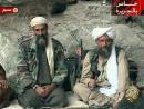
Nov. 30….(Worthy News) Al Qaeda's deputy leader Ayman al-Zawahri said in a videotape broadcast Monday al Qaeda would continue to attack the United States until Washington changed its policies toward the Muslim world. (FOJ Note: That mans the US should change its position of support for Israel) We are a nation of patience and we will continue fighting you (United States) until the last hour," Zawahri said in the excerpts of the tape aired on Arab television Al Jazeera. (FOJ Note: The “last hour” to the Islamic terrorists means the last days when the Mahdi returns to destroy Israel and the infidels!) "Our final advice to America, although I know they will not heed it: You must choose between two methods in dealing with Muslims. Cooperate with them with respect and based on mutual interests or deal with them as free loot, robbed land and violated sanctity," he said. Egyptian-born Zawahri is Osama bin Laden's right hand man and has been pictured traveling with the al Qaeda leader through Afghanistan. He is on the FBI's list of its 22 "most wanted terrorists." The latest video, in which Zawahri was wearing a white turban and sitting with an automatic rifle next to him, appeared to have been taped before the US presidential polls because he said it did not matter to al Qaeda whether Americans chose President Bush or Democratic challenger John Kerry. Zawahri mentioned in passing Iraq's polls which are due to be held in January. "As for the American elections, the two candidates are competing for Israel's favor, that is, competing for the crime against the Muslim nation in Palestine which has lasted for 87 years to continue." "This proves that there is no solution with America except to force it to submit to what is right through force," he said. Al Jazeera last month aired a videotape from bin Laden warning of possible new Sept. 11-style attacks. He said in a full Internet broadcast of the video that Bush had dragged the United States into a quagmire in Iraq and warned of retaliation for Iraqi deaths. Fighters loyal to Washington's top foe in Iraq, Jordanian militant Abu Musab al-Zarqawi, recently pledged allegiance to the al Qaeda leader. Zarqawi's group has claimed the bloodiest attacks in Iraq and hostage beheadings. Zawahri said Arab and Muslim states would share Baghdad's fate if they gave up jihad (holy war) and reiterated Al Qaeda's aim to "purify our countries from aggressors and stand up to whoever attacks us, violates our sanctities or robs our riches." General Abizaid Warns Iran not to Underestimate US Military Nov. 29….(AP) A top US commander is warning Iran and others against thinking they can exploit the US military because its ground troops are fighting two major missions in Iraq and Afghanistan. Why the Iranians would want to move against us in an overt manner that would cause us to use our air or naval power against them would be beyond me," Army Gen. John Abizaid, the head of US Central Command, said in an interview on the way to his headquarters here from Afghanistan. Some members of Congress, including Democratic Sen. Carl Levin of Michigan and Republican Sen. John McCain of Arizona, have expressed concern that there is a shortage of US troops and such a scenario might tempt nations such as Iran and North Korea to increase terrorist activity or develop weapons of mass destruction. Abizaid, the top commander for Afghanistan and Iraq, said any nation perceiving a weakness in the US military should think twice. "We can generate more military power per square inch than anybody else on Earth, and everybody knows it," Abizaid said. "If you ever even contemplate our nuclear capability, it should give everybody the clear understanding that there is no power that can match the United States militarily." The United States has 138,000 troops in Iraq, 20,000 in Kuwait, 18,500 in Afghanistan and 1,300 in Africa to combat terrorism, in addition to deployments in Japan, Korea, Germany and Bosnia. Abizaid said there is no need for a major expansion of the military at this time, even to provide security for Iraqi elections Jan. 30. And the need for such a large US overseas deployment will diminish over time as Iraqi and Afghan forces take over, Abizaid said. "There are plenty of troops to fight the war on terrorism," he said, referring to US and foreign forces. Getting other nations to commit troops "is not a military problem in my mind as much as a political problem. Nations have to come to the conclusion that it is a fight worth fighting." General Abizaid said large operations are not the only way to win battles. He pointed to the recent battle in Fallujah, where 10,000 troops backed by precision air-strikes launched from US ships provided overwhelming force. The US military will however need to be restructured to fight long wars against terrorists and insurgents over the next 20 years, Abizaid said.
Sharon Likely to Meet With Abbas Nov. 29….(My Way) A spokesman for Sharon said Israel would try to use a summit with Abbas "to exploit a window of opportunity" created by the death of Yasser Arafat and move with the Palestinians toward reviving a violence-stalled peace "Roadmap." "When they would like to meet, we will meet," Sharon told Newsweek magazine, when asked whether he was ready to hold talks with Abbas, a moderate former prime minister seen as a potential peacemaker by Israel and the United States. Sharon also suggested he would try to discuss with the Palestinians his plan to remove unilaterally next year all 21 Jewish settlements in Gaza and four of 120 in the West Bank. In a separate Newsweek interview, Abbas said: "After the elections, I'm ready to meet at any time with Sharon." Abbas, who took over from Arafat as leader of the Palestine Liberation Organization, is the leading candidate to replace him as president in the ballot in the Palestinian territories. "There's nothing to prevent a meeting with Ariel Sharon or the Israeli government but it is essential to take the necessary time to convene such a meeting," Abbas told reporters in Cairo, where he was speaking at the Arab League. Israel rejected any talks with Arafat, accusing the late president of fomenting bloodshed in a Palestinian uprising that began in 2000. Since Arafat's death, Sharon has softened his opposition to Palestinian Authority involvement in the planned pullout from Gaza and parts of the West Bank, saying he hoped to avoid a withdrawal under fire from militants. "I am going to make every effort to coordinate our disengagement plan with the new Palestinian government, one that can assume control over areas we evacuate," Sharon said. Abbas said the Palestinians were not yet ready to handle security in Gaza but hoped it would be possible. We are ready to take Gaza when we rebuild our security apparatus, but as of now we have no security apparatus. Sharon pledged Israel would keep its troops away from Palestinian towns during the January election. Israel "will take all the necessary steps to enable them to conduct their elections with as little interference as possible, by opening the roads and taking our forces out of their towns," Sharon said. Looking ahead toward a new Palestinian leadership, Sharon's spokesman, Raanan Gissin, said there could be no quick fixes in getting the peace process back on track. "There can be no way that we can advance on the road map to peace if the Palestinians try to bypass it or take short cuts, without really stopping terrorist activity or dismantling terrorist organizations," Gissin said.
Terror expert: Qaida WMD Attack on US Likely Soon Nov. 29….(Jerusalem Post) An al-Qaida attack on the US with non-conventional weapons is virtually "inevitable," and the organization is likely "tying up the knots" for such an attack, Yossef Bodansky, former director of the US Congressional Task Force on Terrorism and Unconventional Warfare, told The Jerusalem Post on Sunday. "All of the warnings we have today indicate that a major strike, something more horrible than anything we've seen before is all but inevitable," he said. Bodansky, in Israel for the second annual Jerusalem Summit, an international gathering of conservative thinkers, added that "the primary option" for the next al-Qaida attack on US soil would be one that would use weapons of mass destruction. "I do not have a crystal ball, but this is what all the available evidence tells us, we will have a bang," Bodansky said. He said that al-Qaida has not carried out a second major attack on the US until now for internal psychological and ideological reasons, but after the reelection of President George W. Bush, it has gotten "the green light" to do so from leading Islamic religious luminaries, as well as from "the elites of the Arab world." According to Bodansky's reading of Osama bin Laden's mind-set, after the elaborate attacks of 9/11 there was no need for the "bin Ladens of the world" to carry out a second major attack in the US, both because the target audience of the attacks, the Arab and Islamic world had gotten the message that America could be penetrated, and because a second attack would necessarily have to be more grandiose. Following the attacks and the US-led war on terror, a debate started within the operational arm of the organization over the potential use of weapons of mass destruction, Bodansky said. If, in pre-9/11 days, the theme used by bin Laden was that perpetual confrontation and jihad against the US was the only way to protect Islam, the argument now used is the ability to punish American society, Bodansky said. "Just as the West was challenging the quintessence of Islam by means of the globalization era, there was a parallel need by Islamic extremists to strike at, and hurt the core of American society, this time with weapons of mass destruction," Bodansky said. A subsequent theological debate emerged within the organization, and its supporters in the Arab world, he said, over whether the mass killing of innocents is permissible. While bin Laden and his associates argued that by virtue of their participation in US democracy, US citizens were enabling their rulers to fight, other Islamic luminaries contended that this does not permit such massive attacks, Bodansky said. The reelection of Bush in November, he said, was viewed by bin Laden and his cohorts as a decisive answer to this deliberation, with Americans now "choosing" to be the enemies of Islam. In bin Laden's mind-set, he said, the stage was set for a non-conventional attack. Bodansky said that while there may still be some vestiges of debate and doubt within Islamic circles, he believes that planing for such an attack is finished. "They got the kosher stamp from the Islamic world to use nuclear weapons," he said. Moreover, Bodansky said that America is losing the war against terrorism, noting the number of recruits bin Laden is able to count on, as his call to arms gains widespread support throughout the Muslim world. In the pre-9/11 world, Bodansky said, jihadists could count on 250,000 individuals trained and willing to die, and 2.5 million–5 million people willing to help them in one way or another. He cited intelligence estimates from this summer that suggest that as many as 500,000-750,000 people are willing and trained to die, 10 million are willing to actively support them, short of killing, while another 50 million are willing to support such a movement financially. FOJ Note: Bin Laden’s video-taped message released just prior to the US presidential election gave us some insights into the Al Qaeda-Islamic terrorist thinking. If Mr. Bodansky’s theories are correct, and the Bin Laden statements are legitimate, it may be deduced that Islamic radicals are indeed bent on attacking the conservative heartland of America. The Big question that will arise in the event that America comes under another attack is, “will America continue to be bold enough to support Israel in the face of such threats?”
The Gathering Threat to Israel’s Existence Nov. 29….(CBN/By Chris Mitchell) Iran's pursuit of nuclear weapons is considered by some the number one foreign policy decision facing President George Bush. The International Atomic Energy Agency has been debating whether to refer Iran's nuclear program to the United Nations Security Council. And for the tiny nation of Israel, a nuclear Iran also represents a mortal danger. Iran has been branded by the US as the leading state sponsor of terrorism in the world, and it might be just months away from developing nuclear weapons. The countdown to a nuclear Iran is on. "This year and the year 2005 will be dominated by an American effort to define a powerful and effective policy on Iran, being defined as one of containing and stemming and reversing the Iranian drive to have nuclear weapons," said Dr. Uzi Arad, an expert on Iran's nuclear program. Dr. Arad is the head of the Herzylia Institute on Counter Terrorism near Tel Aviv. "They have their own ambitions, they have a very elaborate network of nuclear facilities and they are pursuing the nuclear option with tremendous momentum," he said. That means Teheran is closing in on a nuclear weapon. CBN News has learned that by Israeli intelligence estimates, Iran is six months away from the nuclear point of no return. Caroline Glick of “The Jerusalem Post” said, "That means even if they don't have a nuclear arsenal, they'll be at the point where they will be able to develop nuclear weapons whenever they wish, because they have completed the nuclear fuel cycle, because they have enough enriched uranium to make bombs anytime they wish." Yuval Steinitz, chairman of Israel's Knesset Defense Committee, said, "I think it is the most serious and devastating threat to Israel, the Middle East and to the entire world." Steinitz is aware of the strategic threat if Iran develops nuclear weapons. "They would be able in a few years time to have a stockpile of several hundred nuclear warheads with missiles that can take those warheads not only to the Middle East or to Israel but also to Western Europe. Iran is aiming not to becoming a regional nuclear power but a global nuclear superpower." Iran's threat grows from a regional to a global threat when it combines its nuclear and missile technologies, a development US Secretary of State Colin Powell noted recently. Iran's new missiles, the Shahab 4 and 5, could soon reach London with a nuclear warhead. For Israel, the threat is a lot closer. "We have to understand that 80 percent of Israel's population is located in a very small strip of coastal land, the coastal plain,” Glick said. “A strike against Israel, even one nuclear weapon, would be devastating. Israel would not be able to survive such an attack. So from an Israeli perspective, a nuclearized Iran is a threat we can't live with. "If Iran joins the world's exclusive nuclear club, it would become its most aggressive anti-Israel member. Just two years ago, a leading Iranian mullah pledged Iran would use nuclear weapons to destroy Israel. But the threat extends beyond Israel. A nuclear Iran would shift the balance of power in the Middle East, threaten the flow of oil from the Gulf states, pose a threat to US troops in Iraq, and raise the specter of Iranian-supported groups like Al-Qaeda or Hezbollah acquiring nuclear weapons. Dr. Arad said, "Iran represents a hostile, reactionary, fundamentalist, Islamic form of policy, and any acquisition of nuclear weapons by this kind of regime is a throwback to Medieval times." But can diplomacy restrain a return to the Dark Ages? Some European powers hope so. England, France and Germany recently negotiated a deal where Iran agreed to stop enriching uranium, for a time, in exchange for some incentives. However, some analysts say diplomacy with Iran is like dealing in a "Persian bazaar." Soon after the signing, Iran said it would not be bound by some of the agreement. "So it was absolutely clear while they were negotiating it that the plan, that the accord would have no chance of ending Iran's nuclear weapons program or even stopping it," explained Glick. So what about a military option? Analysts say it would be more difficult for Israel to take out Iran's nuclear program today than it was to destroy Iraq's nuclear facility as it did in 1981. Dr. Arad said, "Well, the Iranians have dispersed their facilities, they have a lot of redundancy, they have camouflage. They have buried, they have hardened some of their facilities in tunnels and underground, so as to make it difficult for the United States and other to hit those targets." Unlike the 1981 Israeli strike on Iraq, Israel's leaders and analysts believe the US needs to take the lead against Iran. Steinitz said, "It's up to the free world, under the leadership of the United States of America to address this global threat." Dr. Arad agreed. "I think this is a test of American leadership, of American resolve, this would be a test of the American administration of the President. But it need not be conducted alone. There should be a coalition, an alliance of like-minded nations, and I trust, when done judiciously and effectively, it would have the desired result." Despite the formidable diplomatic and military challenge, the US, Israel and the world will have to decide if stopping a nuclear Iran, whatever the consequences, is worth the cost. Many believe the cost of not stopping Iran would be much higher. WEEK OF NOVEMBER 21 THROUGH NOVEMBER 25
Arafat’s Path: Destroy Israel Through ‘Peace’ Nov. 24….(JNEWSWIRE) A respected Arab newspaper editor
and Yasser Arafat-confidante said at the weekend the deceased PLO chief had
signed the so-called “Oslo Accords” in order to drive the Jews from the Middle
East. Atwan also revealed that it was Arafat who had personally established his Fatah party’s Al Aqsa Brigades “military” wing, a group featured prominently on the US State Department’s list of known terror groups. "President Arafat was the one who established the Aksa Martyrs Brigades in response to the attempt to marginalize him after the failure of the Camp David summit," he said. Atwan said Arafat rejected the unprecedented offers made by Israeli Prime Minister Ehud Barak at Camp David “because he wasn't prepared to sign a final agreement with the Jewish State.” Just hours after shaking Yitzhak Rabin’s hand on the White House lawn in 1993, Jordanian TV broadcast a pre-recorded message from Arafat to the Arab masses assuring them the agreement he had just signed was merely the first step in his phased plan to destroy Israel. During the speech, he reminded the Arabs of the PLO’s 1974 decision to establish sovereignty in any areas “from which the Israelis withdraw,” and use those areas as a launch pad for further “liberation.” A year later, while most Israelis were celebrating their newfound peace, Arafat admitted to congregants at a Johannesburg, South Africa mosque, in English, that the Oslo Accords had been a ruse. “This agreement, I am not considering it more than the agreement which had been signed between our prophet Mohammed and Quraish,” he said, referencing a deceptive “peace” treaty brokered by Islam’s founder. In 626, Mohammed signed the Hudaibiya Treaty with the Quraish tribe of Mecca. He promptly abrogated the agreement two years later after amassing enough strength to defeat and massacre the Quraish. The Hudaibiya Treaty is also known among Arabs as the “peace of the brave,” a term used often by Arafat to describe the Oslo peace process. Newly appointed PLO chief Mahmoud Abbas and the rest of the “new” PA leadership have pledged to continue in Arafat’s footsteps. The newly empowered “moderate” PA leadership Tuesday pledged to remain true to Yasser Arafat’s platform of seeking to flood Israel with millions of Arab “refugees.” They also insisted there would be no final peace until the PLO flag was raised over a Jerusalem under “Palestinian” sovereignty. PLO chief Mahmoud Abbas reiterated the traditional “Palestinian” unwillingness to compromise knowing the status of Jerusalem and the so-called Arab “right of return” are deal breakers for Israel. That intractable position notwithstanding, Washington continued to tout the legitimizing of Mahmoud Abbas as overall “Palestinian” leader in the upcoming “democratic” PA election as the best chance for achieving peace in the region. "We will follow in the path of the late leader Yasser Arafat, and we will work toward fulfilling his dream," Abbas said during a special session of the Palestinian Legislative Council to commemorate the deceased arch-terrorist, and added there would be no peace with Israel until the “Palestinians” controlled at least half of Jerusalem. Ignoring the “new” leadership’s continued commitment to Arafat’s self-described “phased plan” for the destruction of Israel, US Secretary of State Colin Powell said he believed big changes were in store that would lead to peaceful coexistence. “I think this is a moment of opportunity that should not be lost, and I think that what I have heard today suggests that the Palestinian Authority is committed to reform,” Powell said during a Jericho press conference after meeting with Abbas, Qureia and Fattouh yesterday. Attempting to allay “Palestinian” concerns following Arafat’s demise, Powell told reporters that “President George W. Bush’s commitment to the creation of a Palestinian state, hasn’t changed.” “What has changed is a new set of circumstances in the aftermath of Arafat’s passing. With new leaders coming forward from the Palestinian side, or a new arrangement of leaders on the Palestinian side, and with an election coming up, I think it gives us the opportunity to reenergize the roadmap process.” FOJ Note: The eventual empire of the Antichrist will seek to fulfill the evil scheme that Yasser Arafat envisioned. The Antichrist will pledge safety and security to Israel, but will connive with the Arab world to enact their diabolical plan of exterminating the State of Israel. (Daniel 11:21 And in his estate shall stand up a vile person, to whom they shall not give the honor of the kingdom: but he shall come in peaceably, [peace processes] and obtain the kingdom by flatteries—“through false promises”.) (Daniel 8:25 And through his policy also he shall cause craft to prosper in his hand; and he shall magnify himself in his heart, and by peace shall destroy many: he shall also stand up against the Prince of princes; but he shall be broken without hand.) Anan: Israel Ready to Revive Peace Talks Nov. 23….(Jerusalem Post) The coming Palestinian elections provide an opportunity to revive the Middle East peace process, UN Secretary-General Kofi Annan said Tuesday, adding that Israel is ready for such a step. Annan spoke after talks among world leaders who came to the Red Sea resort of Sharm el Sheik for a conference on Iraq and held a side meeting on the Israeli-Palestinian dispute. Annan said talks with EU foreign policy chief Javier Solana, Russian Foreign Minister Sergey Lavrov and US Secretary of State Colin Powell were dominated by the Jan. 9 elections for a Palestinian Authority president to replace the late Yasser Arafat. Secretary Powell held talks with Israeli and Palestinian leaders and assured them that US President George W. Bush intended to advance the peace process in his second term. Israeli leaders, who boycotted Arafat, told Powell they would ease travel restrictions on Palestinians to facilitate the PA election. "We are all encouraged," Annan said, adding the UN would provide election monitors. "There is an opportunity to move ahead with the roadmap," Annan said, referring to the peace plan sponsored by the United Nations, the European Union, the United States and Russia. "We believe the Israeli government is also ready." The host of the Iraq conference, Egyptian Foreign Minister Ahmed Aboul Gheit, said the Israeli-Arab conflict was as much a threat to the region as the insurgency in Iraq. "Efforts to achieve stability in Iraq cannot be separated from strenuous efforts to achieve peace in the Middle East," Aboul Gheit said. Iraqi Foreign Minister Hoshyar Zebari told the conference his government was committed to holding "full, free and fair elections across the country for the first time in our history." Referring to the recent campaign against insurgents strongholds in cities such as Fallujah and Mosul, Zebari said: "We must guarantee that all sectors of the Iraqi electorate have an equal chance to cast their vote free from intimidation, terror and fear spread by an extreme minority, a lethal mix of Saddamists, foreign terrorists and criminal gangs." Zebari defended the US-led forces in Iraq, which are widely viewed in the Arab world as an army of occupation. "The contribution of the multinational force is essential to help secure necessary conditions for voting and to support our security forces in stabilizing the country," Zebari said. Iran and Syria voiced criticism of the US-led military campaign against the insurgents. The conference has steered away from setting a deadline for withdrawing US-led forces from Iraq, despite a push by France and some Arab countries. The draft communique, though, does say the mandate of foreign forces is "not open-ended." In what could be the most contentious part of the conference, Iraq has said it will ask neighboring states to tighten their borders against the infiltration of would-be insurgents and to share information about groups supporting the militants. Iraqi Prime Minister Ayad Allawi told the AP on Monday that neighboring countries had not pulled their weight against the insurgency. The conference brought together Iraq's six neighbor, Iran, Syria, Turkey, Kuwait, Jordan and Saudi Arabia, plus Egypt and other Arab countries, China, and regional bodies such as the Group of Eight, the United Nations, the European Union, the Arab League and the Organization of the Islamic Conference
Bush Puts Onus On Palestinian Leaders To Lead Peace Efforts Nov. 23….(Bill Koenig) (www.watch.org) No other issue may impact Americans more over the next four years than President George W. Bush's role in establishing a Palestinian state. President Bush has said that he intends to use the next four years to spend the capital of the United States on establishing a free, democratic Palestinian state bordering Israel. President Bush and British Prime Minister Tony Blair last Friday stood side by side in their support for the so-called disengagement plan where Israel voluntarily gives up land to the Palestinians in preparation for this free, democratic state dedicated to peace and the rule of law. The first step in this process, both men said, is the Palestinian people choosing a new President. Former President Yasser Arafat's body hardly cold, and already the first terrorist attack was made in a mourners' tent against interim President Mahmoud Abbas, killing two, wounding six, but sparing Abbas. The Palestinian Authority is under attack by three rival terrorist factions wanting control of the Palestinian movement; all formerly supported by Arafat; Fatah, Hamas, and Islamic Jihad; and all dedicated to the eradication of Israel. There are many people who believe the only way to peace in the Middle East is the establishment of a Palestinian state carved out of Israel's current borders. In fact, much of the Christian church believes that since the Jewish people rejected Christ that the modern Christian church has replaced Israel as God's chosen people. This is grave and erroneous thinking. God has said in Zechariah 2:8 that he who touches Israel, "touches the pupil of God's eye." And the Apostle Paul writes in Romans 11:17, 18 that Christian Gentiles were grafted into God's people, and to "remember that you do not bear the root, but the root bears you." Insider's Take: The Middle East peace initiative impacts Americans because the peace plan requires that Israel give up her covenant land. Israel was reestablished in 1948 in fulfillment of God's word and those who attempt to divide the land of Israel face judgment. If President Bush intends to support a plan to divide Israel to establish a Palestinian state, he will bring judgment upon the United States. God says in the prophecy of Zechariah 12:3, "I will make Jerusalem a very heavy stone to all the peoples; all who would heave it away will surely be cut in pieces." Once again there is a warning--take heed that you are not deceived in these times. Pray for the peace of Israel. Powell Resigned over Bush’s Israel Policy Nov. 23….(FOJ) Outgoing US Secretary of State Colin Powell was asked to step down after telling President George W. Bush he wanted more power to confront Israel over the peace process, according to London's Sunday Telegraph. At the same time, the Sunday Times reported that Secretary of State-designate Condoleezza Rice is convinced Yasser Arafat's death has created a unique opportunity and she believes the revival of the peace process leading to a Palestinian state will be her top priority. Powell was widely rumored to be ready to resign after four years of conflict with Vice President Dick Cheney and Defense Secretary Donald Rumsfeld. However, the Telegraph quoted "friends" as saying he changed his mind because he saw the chance of progress on the peace process and wanted to see through the Iraqi elections. He was reported to have made an unsuccessful pitch to remain in office for at least one more year during British Prime Minister Tony Blair's visit to Washington earlier this month. The paper noted that while Powell's departure was announced on November 15, his letter of resignation was dated November 11, the day of his meeting with Bush. White House officials were quoted as saying that Powell was not asked to stay on. Briefing reporters later, Powell said he and Bush had had "fulsome discussions," diplomatic code for disagreements. "The clincher came over the Mideast peace process," a recently-retired State Department official reportedly said. "Powell thought he could use the credit he had banked as the president's 'good cop' in foreign policy to rein in Prime Minister Ariel Sharon and get the peace process going. He was wrong." Among those who lobbied against Powell were Cheney and Undersecretary of State John Bolton, both of whom want the administration to focus primarily on Iran's nuclear ambitions and the fight against Islamic terrorist groups. Cheney and Bolton, who will be Rice's deputy, were said to fear that Powell would back away from a confrontational approach. They are also frustrated that Britain, France, and Germany are still seeking a diplomatic deal with Teheran rather than backing an immediate UN Security Council resolution condemning Iran and threatening sanctions. Meanwhile, the Sunday Times reported that Rice is said to be sympathetic to the Palestinians' plight and has said she will work tirelessly for a democratic settlement. Rice's style of diplomacy will be very different from that of Powell. "She believes in old-fashioned diplomacy, where you get on a plane and you go to the capital and meet your counterpart. Rice's met with Natan Sharansky and assured him that bringing democracy to the Middle East would be "the centerpiece" of US foreign policy over the next four years. Sharansky was in Washington to promote his latest book, The Case for Democracy, on how to beat terrorism. Rice told him, "You know why I am reading your book? Because the President is reading your book and he thinks I should read it." FOJ Note: Democracy is nice, but what the people of the Middle East need the most is the Gospel of Jesus Christ. It will bring true liberty to the Arab world, and the nature to live in peace with Israel. UN Employees: No Confidence in Annan Nov. 22….(World Net Daily) Could Kofi Annan be forced from his perch as United Nations secretary-general before his second term expires in 2006? That's the buzz around UN headquarters in New York as the global organization's employees recorded a vote of no-confidence, citing "upper management" at the world body, but clearly aiming at Annan. The UN staff revolt reached a peak when Annan gave a pass to official Dileep Nair, who had been accused of sexual harassment of employees and hiring favoritism. The UN staff had called for a formal probe of Nair's behavior. Annan is being called a "cover-up artist" by some sources within the UN. The latest scandal comes on the heels of last month's revelation that Annan aide Benon Savan, the man behind the Oil-for-Food program, previously ran a relief operation for war-torn Afghanistan in the 1980s and '90s that was likewise riddled with waste, fraud and abuse. In fact, only a last-minute switch of tactics by the UN employees caused them to make their no-confidence vote less personal. Originally, the plan was to record the vote against Annan himself, rather than upper management. "Kofi Annan's tenure as secretary-general is running on borrowed time," said Tom Kilgannon of Freedom Alliance, a group that serves as a watchdog on the UN "He is presiding over a corrupt and failed institution and the professional bureaucrats at the UN understand that the best chance they have of saving their jobs and their beloved UN is to dump Mr. Annan overboard. Should they do so, Mr. Annan will join Kurt Waldheim and Boutros-Boutros Ghali in the annals of history as disgraced and failed UN leaders." There is talk within UN circles of replacing Annan with a more charismatic, high-profile figure before his second term lapses in 2008. One of the names frequently mentioned is former President Bill Clinton. "Mr. Annan has been criticized by his own people for stonewalling independent investigations into the Oil-for-Food scandal; for failing to provide adequate security to UN staff in Iraq last year, and failing to hold accountable those who were in charge of Iraq security operations; and for pardoning Dileep Nair, the UN's top oversight official, who UN employees accused of sexual harassment and violating UN rules governing employment practices," said Kilgannon. He continued: "Kofi Annan is in deep trouble. His leadership is tainted and his own people have lost faith in him. It will be difficult for him to remain secretary-general and be effective in the job. This is also an opportunity for the Bush administration "to rid themselves of Kofi Annan who has fostered anti-American sentiment and stymied US plans to liberate Iraq.
Everybody Wants Abbas – Except the Palestinians Nov. 22….(Debka) Most world leaders are tabbing Mahmoud Abbas as Yasser’ Arafat’s punitive political successor and great white hope for a brighter future and an end to a dismal conflict, yet every intelligence report predicts he will be tripped up before the election by the Palestinians themselves. Most analysts would not be surprised if he was even assassinated by terror groups bankrolled from Tehran and the Lebanese Hizballah or by terrorist factions in his own Fatah. Inside the Fatah, the Tanzim fighting wing launched Sunday, November 21, a campaign to collect 250,000 signatures for the nomination in his stead of jailed West Bank Fatah leader Marwan Barghouti as the party’s candidate. The fiery Barghouti is serving a life sentence in Israel for staging terrorist murders of dozens of Israelis. To avoid a Fatah split, there is also a proposal for him to stand as Abbas’s running mate. Should Abu Mazen steps aside, Prime Minister Ahmed Qureia could quickly step forward to replace him. In a show of no-confidence, Hamas, the Palestinian “Fronts” and left-wing groups are shopping for nominees capable of beating Abbas. Most analysts consulted by Debkafile are of the opinion that even if Abu Mazen won the election, he would not last long. His radical enemies remain up in arms at his rejection of the Arafat doctrine of terror, (Prime Minister Qureia has never repudiated the use of terror like Abbas did) and they wield the destabilizing threat of violent riots, terror and mayhem, especially in the Gaza Strip. Local terrorist chiefs and militia commanders will flaunt their rejection of his authority. Once Abu Mazen is disposed of, the Palestinian Authority is expected to implode internally; paramilitary groups subsisting on terrorism, protection rackets and armed robbery will reduce the Gaza Strip and parts of the West Bank to warring fiefdoms. While Ariel Sharon persists in publicly offering Abu Mazen assistance, he places little trust in his chances of assuming office and any real control. In fact, Sharon has told insiders he expects the next two months to bring serious outbreaks of terror and deepening chaos in Palestinian areas. The weakness at the new Palestinian helm is clearly visible in several ways. 1. A week after Abu Mazen was surrounded in the Gaza Strip by three dozen gunmen shooting in the air, no arrests have been made and no punishments meted out, because neither the Palestinian police nor security services are prepared to act on his behalf, or even for his protection. There was a literal firefight between rifle-toting Fatah militants and Mazen’s bodyguards at a mourning tent in Gaza City, which left two PA security men dead and their startled charge running for cover. The November 14th exchange of bullets came just minutes after the armed activists marched into the tent while chanting that the newly crowned PLO chief was a “traitor” to Arafat’s sacred cause. The incident was clearly staged to show Abbas that Hamas could eliminate him in a moments notice. 2. Hamas and other radical groups are threatening to boycott the January election. 3. The week Abbas and Qureia spent in Gaza ended in fiasco and humiliation. Hamas sent them packing back to Ramallah because they are seen as endorsers of the Middle East roadmap and Abbas’s condemnation of terrorism offered publicly at the June 2003 Aqaba summit with President Bush and Prime Minister Sharon does not sit well with the Hamas or Islamic Jihadists. 4. The French government’s coyness in handing over the medical files covering Arafat’s last days in the Percy military hospital has piled on new trouble for the Abbas-Qureia duo. Some rumors running rife in the Palestinian street not only accuse Israel of poisoning him but suggest that his would-be successors may be complicit in the crime. The PA set up an official inquiry panel to find out the truth and sent the dead leader’s nephew Nasser al-Kidwa, the Palestinian UN delegate, to Paris to claim the documents. Before he arrived, the widow Suha Arafat took possession of the precious files and absconded with them to Tunis. Still, as a close kinsman, al-Kidwa hopes the French authorities will grant him access on Monday, November 22. Suha is holding onto the records both as warranty for her safety and her promised “pension” and as a weapon to hang over the heads of the moderates preparing to step into her husband’s shoes, or even place them at the disposal of his radical Palestinian opponents, such as Kaddoumi. WEEK OF NOVEMBER 15 THROUGH NOVEMBER 21
Iran, China Forming Major Alliance Nov. 19….(Newsmax) Just as the foreign policy team of the United States is getting a major overhaul with the resignation of Secretary of State Colin Powell comes new word of a major, growing alliance between "axis of evil" member Iran and communist China. The relationship, which has been nurtured by both countries for decades, is growing exponentially now, primarily out of China's insatiable energy needs (FOJ has documented China’s growing dependency on Arab oil) and Iran's increasing hunger for consumer goods, as the economies of both countries continue to expand. What that means for the United States in the short term is an inability to pressure the Islamic republic into following policies beneficial to Washington. What it could mean for the long haul is a stronger, more menacing Iran and China, each buoyed by needs being met by the other. According to the Washington Post, China's energy needs have climbed nearly 40 percent in the first months of 2004. Meanwhile, Iran, whose population has doubled since the 1979 revolution is increasing meeting those needs in exchange for access to China's burgeoning low-cost manufacturing industry. For all intents, the match is a natural. But things weren't always rosy between the two nations. Before the Islamic revolution, the last Chinese official to meet with the late Shah Mohammed Reza Pahlavi was Chinese Communist Party chief Hua Kuo-feng. The meeting "left a very strong negative feeling about China among Iranians," Abbas Maleki, director of the Caspian Institute, a Tehran research organization, told the Post. Ties have improved greatly since then, however. In August 2001, Iranian Ambassador to China Mohammad Hossein Malaek held a reception in Beijing to mark "the 30th anniversary of the establishment of diplomatic relations between Iran and China," China's People's Daily reported. "In terms of economic relations, China has become one of the most important trade partners of Iran," said the paper. In March 2002, Wu Yi, a member of China's State Council, made a visit to Iran to meet with President Mohammad Khatami. Again, the focus of the visit was to improve trade and economic ties. "The bilateral trade between China and Iran has increased fast in recent years, with trade volume reaching some 3.3 billion US dollars last year, several times higher than that some 10 years ago," People's Daily reported. In August 2003, the Iran's IRNA reported that Foreign Minister Kamal Kharrazi traveled to Beijing for more economic talks with Wu, giving precedence to "transportation, construction of dams, power plants, petrochemical industry along with gas and oil projects." And in July of this year, Iranian Parliament Speaker Gholam-Ali Haddad Adel praised the Sino-Iranian relationship, highlighting Beijing's support for Iran's nuclear programs. Economically, the cooperation between both nations now amounts to hundreds of billions of dollars over many years. For instance, said the Post, in October "the two countries signed a preliminary accord worth $70 billion to $100 billion by which China will purchase Iranian oil and gas and help develop Iran's Yadavaran oil field, near the Iraqi border." And, "earlier this year, China agreed to buy $20 billion in liquefied natural gas from Iran over a quarter-century," the paper continued. For Iran, however, more is better when it comes to China. Iranian Oil Minister Bijan Zanganeh said this month, according to China Business Weekly, "Japan is our number one energy importer for historical reasons, but we would like to give preference to exports to China." That position, no doubt, will not set well with Japan, which has seen its relationship with China cool in recent years. Just last week Japan detected a Chinese nuclear submarine in its territorial waters, perhaps not ironically near underwater natural gas fields and several islands surrounded by rich fishing waters claimed by Japan. China and Iran are currently cooperating on about 100 different projects, many of them infrastructure- and energy-related. Perhaps the most troubling aspect of the growing Iran-China
alliance is the Islamic republic's access to the improving technology being
developed, deployed and utilized by the People's Liberation Army. Nowhere are
US concerns greater than in the area of ballistic missile technology.
American officials have sanctioned Chinese companies for improperly transferring
such technology in January 2002 and as recently as early this year, but that
hasn't stopped the transfers, experts and analysts believe. And now, as Iran
continues to develop its nuclear program, US, and Israeli officials worry
Iran is using the missile technology to build better weapons – weapons that
eventually could carry nuclear warheads. In terms of its nuclear weapons
ambitions, the UN's nuclear watchdog, the International Atomic Energy Agency,
has determined that China, along with Pakistan and Russia, have probably
provided nuclear technology to Tehran. Politically, the two countries share a common interest in checking the inroads being made by NATO and the US in Asia. And, as the US moves to contain China, along with the two remaining "axis of evil" countries, the name given to Iraq, Iran and North Korea by President Bush in his first term, the China–Iran alliance is only likely to strengthen. According to the CIA, the most likely threats to the US in the future, besides terrorism, are Iran and China. In an ominous February 2001 warning, months before the 9/11 attacks, the CIA warned that Osama bin Laden and his associates continued to pose the most immediate danger to Americans, former CIA Director George Tenet told lawmakers. But in addition to bin Laden, a threat which has been borne out, Iran and China also made the list. "Never in my experience has American intelligence had to deal with such a dynamic set of concerns affecting such a broad range of US interests. Never have we had to deal with such a high quotient of uncertainty," Tenet told the Senate Select Committee on Intelligence. Iran posed a dual threat because of its propensity to sponsor terrorism and its pursuit of first-rate conventional military might. US intelligence analysts and Bush administration officials have expressed concern that, with the help of terrorist-sponsoring nations like Iran, al Qaeda or another terror group could eventually acquire a nuclear weapon or other weapon of mass destruction to use against the continental United States.
Iran: Top Issue For Bush’s Second Term Nov. 19….(FOJ) While he is assembling a new National Security team, (Condoleeza Rice as Secretary of State) President Bush is also grappling with having to confront what could become the second biggest challenge of his second term: how to contain the threat of an Iranian-terrorist nuclear bomb, and the threat a nuclear Iran poses to Israel. The first challenge will be formulating a Biblical position for America as Europe and the UN push the Administration towards implementing the Peace Roadmap between Israel and the Palestinians. That quagmire has dire consequences for the President, and for America. But as the President keeps one eye on the Iranian nuclear ball, he must also be concerned about the Euphrates River Valley hornets nest that is the burdensome terror-insurgency war in Iraq. During the 90’s, the Clinton Administration coerced Israel into making peace with the world’s most notorious terrorist. (Yasser Arafat) and Israel paid a terrible cost in lives, economic ruin, and political blackmail. According to Bible prophecy, the continuation of diplomatic arm-twisting on Israel will only result in a curse and terror backlash upon America. I have no doubts that the war experience for America in Iraq will descend into a terrorist nightmare on the order of that experienced by Israeli’s during the 90’s as they tried to make peace with Arafat, and struggled to combat his terrorist infrastructure. All the while Israel attempted to put down the PA terror war on Israel, the world’s elitist core of international diplomatic leadership made life intolerable for Israel. They have already begun such a media campaign against the Bush Administration, as evidenced in the recent presidential campaign, and reflected in the geo-political hypocrisy of the UN and the EU. Many people question the wisdom of going into Iraq by the Bush Administration, but as we look on the geo-political horizon and envision the next tactic in the global war on terror, it makes sense to have taken down Iraq. One quick glance at a map of the Middle East shows that America and its coalition of anti-terrorist friends have Iran completely encircled! It is undoubtedly hoped that Iran will change its behavior, as far as its nuclear ambitions and its venomous support for Islam terrorism. But prophecy portends that Iran will not change its ambitions to destroy Israel, but that they will ultimately look to Russia for help in forging a coalition of nations to intrude into the Arab-Israeli Conflict. The question is timing, and the fact that we are seeing Iran take its predicted course already shows that we are indeed in the Last Days. ACLU Threatens Louisiana Abstinence Program Nov. 19….(World Net Daily) The American Civil Liberties Union has threatened to sue the state of Louisiana because a state website promoting abstinence mentions God. In a six-page letter, the ACLU claims the state abstinence program has violated a 2002 court settlement by invoking the name of God and quoting biblical passages on the program's taxpayer-funded website, reported the New Orleans Times-Picayune. The legal group says it will take the Governor's Program on Abstinence back to federal court in 30 days if religious references are not removed from the site. Even so, the site, AbstinenceEdu.com continues to mention God, with one personal testimony from a girl who said she thanked God after she chose not to have sex. "We've been monitoring the website for a while," Joe Cook, the executive director of the Louisiana ACLU, told the New Orleans paper. "We thoroughly researched it, and we made the determination that the GPA had not only failed to correct the errors of its ways, as pointed out two years ago in the settlement, but in fact had gone out of its way to use taxpayer money to layer religious content upon religious content." A spokesperson for Gov. Kathleen Blanco's office, Roderick Hawkins, said the website was being reviewed. "Our concern is that the site comply with the agreement and the settlement of 2002," Hawkins told the paper. "That's what we're doing right now, making sure the site complies." On the site's message board, one teenager poster mentioned God in her testimony: "Virginity is something very special which we have been given by God and we can only have it once. When you give it to someone, it'll be gone and you can never get it back no matter how rich you are. I'm so thankful to God for being with me and giving me the wise choice, to abstain. I'm 15 and so proud to be a virgin and I won't be sorry for that. I think one day my future husband will be very happy for the decision which I made and he'll respect me, trust me and feel secure with me." US: Evidence Shows Syria is Aiding Iraq Insurgency Nov. 18….(MENL) The United States has quietly determined that Syria helped finance the Sunni insurgency in Iraq. Officials said the regime of President Bashar Assad has used the state-owned Commercial Bank of Syria to relay hundreds of millions of dollars to Saddam Hussein loyalists in Iraq. They said the money has been employed to finance the insurgency against the US-led coalition primarily in Iraq's Sunni Triangle. The Commercial Bank of Syria held more than $1 billion in Saddam regime accounts on the eve of the US-led war in Iraq in March 2003, officials said. Most of that money stemmed from Iraqi arms and oil smuggling as well as illegal commissions obtained from Iraqi oil sales overseen by the United Nations. Officials said that over the last 18 months Damascus transferred up to $800 million of Saddam's assets to senior aides of the former president, several of whom have been based in Syria. They said much of the money was believed to have been transferred to ex-Iraqi Vice President Izzet Ibrahim Al Douri, identified as the chief financier of the Sunni insurgency. Iran Trying to Equip Missiles With Nukes Nov. 18….(USA Today) The United States has intelligence indicating Iran is trying to fit missiles to carry nuclear weapons, US Secretary of State Colin Powell said. Powell partially confirmed claims by an Iranian opposition group that Tehran is deceiving the United Nations and is attempting to secretly continue activities meant to give it atomic arms by next year. "I have seen intelligence which would corroborate what this dissident group is saying," Powell told reporters, and it should be of concern to all parties." Powell said the intelligence indicates that Iran "had been actively working on delivery systems" capable of carrying a nuclear weapon. Powell said there is no evidence to suggest that Iran has developed the technology to make a nuclear weapon, but suggested that the regime is working overtime to adapt missiles for nuclear warheads. "I'm talking about information that says that they not only had these missiles, but I'm aware of information that suggests they were working hard as to how to put the two together," Powell said. A senior official for the National Council for Resistance in Iran said Tuesday that a bomb diagram, along with an unspecified amount of weapons-grade uranium was provided to Iran by Abdul Qadeer Khan, the disgraced former head of Pakistani's nuclear development which was tied to both Iran and Libya. He said the designs were handed to the Iranians between 1994 and 1996, while Khan delivered HE, highly enriched uranium in 2001. Banned in the United States as a terrorist organization, the group was instrumental in 2002 in revealing Iran's enrichment program in the central city of Natanz, based on what it said was information provided by sources in Iran. The opposition group says a facility at Lavizan-Shian northeast of Tehran was part of a secret nuclear weapons program. Powell declined comment on Khan, but said "for 20 years the Iranians have been trying to hide things from the international community." Iran says its sole interest is to generate nuclear fuel through low-level uranium enrichment, but the United States suspects Iran wants to produce weapons-grade enriched uranium. Enrichment does not violate the Nuclear Nonproliferation Treaty but the International Atomic Energy Agency and most of its members want Iran to scrap enrichment plans as a confidence building measure. Iran announced suspension of enrichment last week, and the agency said it would police that commitment starting next week, in advance of a Nov. 25 IAEA board meeting. The pledge reduced Washington's hopes of having the board refer Iran to the UN Security Council for alleged violations of the Nonproliferation Treaty. Tehran has not dropped plans to run 50,000 centrifuges to enrich uranium for what it says will be the fuel requirements of a nuclear reactor to be finished next year. It currently possesses less than 1,000 centrifuges. But if it added 500 centrifuges, experts say Iran would be able to make enough weapons-grade uranium to make a bomb annually.
White House Reacts With Caution to Russia Nov. 18….(AP) The White House reacted cautiously Wednesday to Russian President Vladimir Putin's statement that his country is developing a nuclear missile," of the kind that other nuclear powers do not and will not have." White House press secretary Scott McClellan said it wasn't news to the Bush administration, that President Bush and Putin had discussed the issue previously. He emphasized US-Russia agreements in place to reduce the two countries' nuclear arsenals and Washington's view of Moscow as a crucial partner in the anti-terror battle. "This is not something that we look at as new," he said. "We are very well aware of their long-standing modernization efforts for their military. We are allies now in the global war on terrorism." McClellan suggested that close ties between Bush and Putin makes alarm unnecessary, but that it doesn't eliminate Washington's concern. "We have a very different relationship than we did in the Cold War," he said. "The fact that we do have a good relationship enables us to speak very directly to our Russian friends." Putin said earlier Wednesday that Russia is researching and successfully testing new nuclear missile systems, the ITAR-Tass news agency reported. "I am sure that they will be put in service within the next few years and, what is more, they will be developments of the kind that other nuclear powers do not and will not have," Putin was quoted as saying
Detained Christian Leader in Iran May Face Death Penalty Nov. 18….(The Christian Post) One of the ten evangelical church leaders of the Assemblies of God Church in Iran reportedly released from detention by police authorities on Sept. 12 may possibly be charged with “espionage” and face the death penalty, sources reported today. According to Italy-based Asia News, Reverand Hamid Pourmand, a Protestant convert from Islam, was moved by Iranian authorities to a military prison, and may possibly be tried by a military tribunal. “Chances that Hamid Pourmand will be sentenced to death are growing,” Asia News reported. “His conversion alone, which a friend said he never kept secret, is ground for the death penalty for, under Islamic law, apostasy is a capital crime.” Born a Muslim, Pourmand converted to Christianity 25 years ago. On September 9, Pourmand and 85 other evangelical church leaders were arrested as they gathered for the first day of the annual general conference of Assemblies of God in Iran at the church’s denominational center in Karaj, 18 miles west of the capital Tehran. Sources say shortly before the meeting began, police burst in, arresting everyone in attendance. After being interrogated, all those detained were released by nightfall except for ten pastors and elders. When the pastors were released separately late on the night of Sept. 12, they were strictly warned not to contact one another or other members of the church. As a result, it was not until the morning Sept. 15 that the Assemblies of God leadership discovered that Pourmand was in fact still missing. Since then, Pourmand was presumed to still be under police arrest in the Karaj-Tehran area. Now, as Iranian authorities have still refused to give any reason for Pourmand’s arrest and prolonged detention, concern has been growing among Iran’s evangelical community for the safety of the lay pastor. According to Asia News, government officials have in recent months repeatedly denounced “foreign religions”, which they accuse of threatening national security. Several former Muslims who converted to Christianity have been executed by court order on “espionage” charges. Since the government-ordered execution of convert pastor Hussein Soodmand in Mashhad in December 1990, the Islamic Republic of Iran has enacted a harsh crackdown against the country’s evangelical churches and various house-church movements accused of evangelizing Muslims. In July 1994, Assemblies of God pastor Mehdi Dibaj, another long-term convert to Christianity, was murdered six months after completing a nine-year prison sentence for refusing to recant his Christian faith and return to Islam. In another incident two years later, the body of Pastor Mohammed Bagher Yusefi was found hanging in the forest near his home in Sari, in northern Iran’s Mazandaran province. Survived by his wife and two children, 34-year-old Yusefi had converted to Christianity 10 years earlier. Asia News reports that over the past decade, local Protestant congregations have been harshly suppressed by the Iranian authorities for allowing Muslims to visit their services or for being suspected of baptizing former Muslims converting to Christianity. There are about 360,000 Christians in Iran out of a population of 65 million. Of these, 335,000 are Protestants. UN Oil-for-Food Money Went to Palestinian Bombers' Families Nov. 17….(Fox News) Money from the United Nations Oil-for-Food program helped pay the families of Palestinian homicide bombers, the House Committee on International Relations is expected to reveal Wednesday during a hearing on corruption in the Iraqi relief program. Investigators working for Illinois Republican Rep. Henry Hyde, chairman of the panel, are expected to say they have traced funds from former Iraqi President Saddam Hussein's kickback scheme through a Jordanian bank and into the hands of families of bombers who attacked Israeli citizens. It has long been established that Saddam paid bounties of $15,000 to $25,000 to the Palestinian families of the murderers. Hyde's committee will reveal at the hearing that some of the reward money was deposited from illegal profits Saddam made by demanding 10 percent kickbacks on all the contracts of companies that did business with the UN's Oil-for-Food program. Those funds were then deposited with other Iraqi money, such as Jordanian Oil-for-Food oil payments, into the Central Bank of Iraq account in the Rafidain Bank in Amman, Jordan. The funds were then transferred to another account in the bank controlled by Iraq's ambassador to Jordan Sabah Yaseen. It was from Yaseen's account that Saddam's officials would cut and hand out checks to the homicide bombers' families.
Palestinian Militants Reject Abbas’s Pre-election Truce Nov. 17….(MSNBC) Islamic militant groups behind many suicide bombings dismissed on Tuesday a call from interim Palestinian leader Mahmoud Abbas to halt attacks ahead of a Jan. 9 election to replace long-time leader Yasser Arafat. Abbas, who is trying to work out a deal with rival Palestinian groups on a cease-fire and possible power-sharing, resisted a call by the groups for a share of power despite their planned boycott of the Jan. 9 election. Hamas and Islamic Jihad do not accept the presence of a Jewish state in the Middle East. Abbas, 69, is the leading candidate in the race to replace Arafat as president of the Palestinian Authority, but he won’t run unopposed. Younger members of his Fatah movement favor Marwan Barghouti, the West Bank Fatah leader serving five life terms in an Israeli prison. At least two independent candidates are considering running as well. Oil Supply I: The Arabs look to the East Nov. 16….(International Herald Tribune) Saudi Arabia is
looking for new friends and finding them, in Asia. (more specifically in
China) The oil-rich kingdom feels spurned and disliked by its traditional
close allies in the West; ties that have never been quite as warm since Sept.
11, 2001. Saudi Arabia sits on about a quarter of the world's reserves of crude
oil, and Asia needs oil. A lot of oil! China is already the second-largest
energy consumer after the United States, and last year it overtook Japan as the
world's second-largest consumer of petroleum products. This explains why
Saudi Aramco, the kingdom's largest oil company, now does almost half of its
business in Asia and has more offices there than anywhere else in the world. "We
consider Asia a strategic market with growth potential, and believe it will
become even more so, especially with the growing energy demands of China and
India," says Ali Bakhsh, regional vice president for Saudi Aramco in Singapore.
Recently, the Saudi government awarded a natural-gas prospecting concession to
Sinopec, a major Chinese oil company. Saudi Aramco says it is currently in
discussions about the expansion of an oil refinery in China's Fujian Province,
and earlier this summer, a major deal was concluded with Shell to acquire an
interest in Showa Shell, a large Japanese refining company. Saudi Aramco also
has an agreement with Sumitomo Corp. of Japan for a feasibility study to upgrade
another refinery on the west coast of Saudi Arabia. Additionally, Saudi Aramco
holds significant equity interest in Petron Corp. in the Philippines and in
South Korea's S-Oil Corp. For China of course, securing a reliable energy supply
has become a key policy imperative. This explains why Beijing put its
international credibility on the line in September to fend off UN sanctions
against Sudan, where China hopes to secure close to 10 percent of its oil
imports in the coming year. It also explains why Chinese oil executives are
risking their lives to secure oil concessions in Iraq. There are of course
political implications that stem from closer Asia-Middle East contacts. Asia's
historical ties with the Middle East are complex and sophisticated. While Europe
sought to conquer the Arab lands, Asia was itself the target of Arab conquest,
which led to the Mongul Empire and the bringing of Islam and aspects of Arab
culture all the way to remote islands in the Indonesian archipelago. As a result
of Arabian-inspired missionary and trade activity, Asia is home to the
world's largest Muslim population, and its earliest trade networks owe their
establishment to links with the Middle East. This familiarity with the
Middle East, although dormant since the rise of European power in the 18th
century, could easily be nurtured back to life, using oil trade as the basis for
a re-integration of West Asia with East Asia.
Pentagon OKs Boy Scout Ban for God Connection Nov. 16….(Newsmax) The Pentagon has agreed to warn military bases worldwide that they should not directly sponsor Boy Scout troops, partially resolving claims that the government has improperly supported a group that requires members to believe in God. The settlement, announced Monday, came in a 1999 lawsuit filed by the American Civil Liberties Union of Illinois, which says American military units have sponsored hundreds of Boy Scout troops. "If our Constitution's promise of religious liberty is to be a reality, the government should not be administering religious oaths or discriminating based on religious beliefs," said ACLU attorney Adam Schwartz. The Pentagon said it has long had a rule against sponsorship of non-federal organizations and denied the rule had been violated. But it agreed to send a message to posts worldwide warning them not to sponsor Boy Scout troops or other such groups. Justice Department spokesman Charles Miller said the message that will be sent to bases represents "a clarification of an existing rule that DOD personnel cannot be involved in an official capacity in anything that promotes belief in God."
Saddam Made $21B From UN Program Nov. 16….(My Way) Saddam Hussein's regime made more than $21.3 billion in illegal revenue by subverting the UN oil-for-food program and other sanctions, more than double previous estimates, according to congressional investigators. New figures on Iraq's alleged surcharges, kickbacks, and oil-smuggling dating back to 1991, are based on troves of new documents obtained by the US Congressional committee's investigative panel. The documents illustrate how Iraqi officials, foreign companies and sometimes politicians allegedly contrived to allow the Iraqi government vast illicit gains. The findings also reflect a growing understanding by investigators of the intricate schemes Saddam used to buy support abroad for a move to lift UN sanctions. The Committee’s Senator Coleman said he is angry that the United Nations has not provided documents and access to officials that investigators need to move ahead. Officials must get to the bottom of the allegations because, among other things, it will help the international community to better design future sanctions programs, some senators said. "That humanitarian program was corrupted and exploited, for the most horrible and aggressive purpose" of raising money for Saddam's military, said Sen. Joseph Lieberman, D-Conn. Previous estimates, one from the General Accountability Office and the other by the top US arms inspector Charles Duelfer, concluded that Saddam's government brought in $10 billion illicitly from 1990 to 2003, when sanctions were in place. But congressional investigators found that vastly more oil, totaling $13.7 billion was smuggled out of Iraq than previously thought.
Europe Compelling US to Gang up on Israel Nov. 16….(JNEWSWIRE) In the wake of US President George W. Bush’s reelection, Washington and the European Union are set to mend fences by launching a joint initiative to jumpstart the drive for a Palestinian State in the heartland of biblical Israel. The effort is being driven by British Prime Minister Tony Blair, who sees American support for the swift implementation of a two-state solution to the Israeli-Arab conflict as the best means to heal rifts created in Europe by the war in Iraq. Mr. Blair wants President Bush to make the Middle East “peace” process the focus of his second term. Alongside Blair’s maneuvering, EU foreign policy czar Javier Solana last week released his own “action plan” aimed at using Prime Minister Ariel Sharon’s Gaza retreat to revitalize stalled implementation of the Middle East Roadmap. Sharon has insisted the Gaza pullout is a unilateral move being taken because there is no partner on the “Palestinian” side, and that the Road Map, while still accepted by Israel, must be temporarily frozen until the Arabs stop murdering Jews. The EU, meanwhile, is said to be drafting plans to deploy a peacekeeping force to the Gaza Strip following Israel’s withdrawal, making future IDF anti-terror incursions next to impossible. So, Israel on the chopping block. The American-led war in Iraq has created deep rifts between Washington and its British ally and the rest of Europe. Following Bush’s reelection last week, Blair made it clear the president’s second term must be focused on healing those rifts by making common cause of the Israeli-Arab conflict. “I have long argued that the need to revitalize the Middle East peace process is the single most pressing political challenge in our world today,” Blair said. Coming dangerously close to using the so-called “Israeli occupation” to legitimize Muslim violence, Blair urged relentlessness in both “our war against terrorism and in resolving the conditions and causes on which the terrorists prey.” Analysts concur that the best route towards reconciliation would be for the US to join Europe in a unified drive to “solve” the Israeli-Arab conflict by establishing a Palestinian state on ancient biblical Jewish lands. It is widely believed that had he won the election, John Kerry would have quickly sacrificed Israel’s national interests in order to realize his deep desire to realign with France and Germany. Supporters of the Jewish State now fear Bush may take a page from Kerry’s playbook as he looks to maintain amicable ties with Blair. Israeli government spokesman Ra’anan Gissin noted that the only stumbling block to implementing the Road Map is the PA’s ongoing failure to curb the terrorist murder of Israel’s Jews. Bush Plans to Expend US Capital on PLO State Nov. 15….(JNEWSIRE) US President George W. Bush intends to use his second four-year term as leader of the free world to expend America’s “capital” on birthing a Palestinian Arab state on ancient Jewish lands. So he said in a joint press conference with British Prime Minister Tony Blair Friday at the White House. Blair was in Washington to push Bush into joining a new initiative to impose “peace” on Israel and the “Palestinians,” the ultimate aim of which is to cool international tempers following the American and British invasion of Iraq. Chief among Blair’s concerns was a disgruntled Europe, where France is clamoring for the immediate creation of a Palestinian Arab state to offset growing Islamic displeasure with the West. A top “Palestinian” official, meanwhile, said not to expect anytime soon to see the PA curb anti-Jewish terror, Israel’s primary prerequisite to restarting meaningful negotiations with the Arabs. President Bush’s statement that he plans “to use the next four years to spend the capital of the United States” on helping to finalize the Muslim re-conquest of Israel’s biblical heartland may have come as a surprise to millions of those who voted for him. Bush is believed to owe his presidency to the tens of millions of American Evangelical Christians, a sector of society that clings firmly to its belief in the Bible and the Israel-centered plan of divine redemption outlined therein. The president attempted to counterbalance any frustration over his drive for a Palestinian Arab state by playing to another passion among his conservative constituents, the love of democratic freedom. The goal of solving the Israeli-Arab conflict by creating a Palestinian Arab state “can be reached by only one path: the path of democracy, reform, and the rule of law,” he told reporters. “We're committed to the success of the upcoming PA elections, and we stand ready to help. We look forward to working with a Palestinian leadership that is committed to fighting terror and committed to the cause of democratic reform.” “I believe that the responsibility for peace is going to rest with the Palestinian people's desire to build a democracy. I don't think there will ever be lasting peace until there is a free, truly democratic society in the Palestinian territories that becomes a state,” he continued during a Q&A session. Bush’s comments, coupled with his refusal to send an official envoy or convene a new peace summit until after the PA had proven itself, were largely seen as a return to the policies laid out in his June 2002 speech, when he demanded the replacement of the current “Palestinian” leadership with one untainted by terrorism and corruption. That the “Palestinians” failed to meet his demands, however, did not stop President Bush from endorsing the Roadmap “peace” plan and pushing for more Israeli concessions. Instead, Bush, along with the rest of the West, pointed to the change in title of one of the PLO’s old “terror-tainted” officials, Mahmoud Abbas (Aka, Abu Mazen), as progress. It remains to be seen if the president will hold fast to his latest demand for “Palestinian” democracy, or will continue to allow the perpetuation of the PLO regime and his failure to end the terrorist onslaught against Israel’s Jews. Either way, by his own admission, Bush is more determined than ever to see the establishment of a sovereign Islamic state on lands explicitly promised to the Jewish people by the Almighty. “I think it is fair to say that I believe we've got a great chance to establish a Palestinian state, and I intend to use the next four years to spend the capital of the United States on such a state,” he stated. “I'd like to see it done in four years. I think it is possible.” ‘We want Palestine now!’ France, meanwhile, signaled its desire to move much faster toward the goal of “Palestine.” "I think it is possible to go faster. The sooner the better, even before the end of Bush's mandate," French Foreign Minister Michel Barnier told Europe-1 radio. Barnier said the US and Europe should consider creating immediately, “perhaps even with temporary borders, this Palestinian State, which is one of the conditions for peace and security for all the countries in this region.” Back in London, Blair has been under intense pressure to resolve the Israeli-Arab conflict as a means of atoning for his “sin” of joining Bush’s invasion of Iraq, a move that has proven widely unpopular among the public and his own Labour Party. It was against this backdrop that the British Prime Minister traveled to Washington last week with the hope of persuading Bush to join an accelerated initiative to establish a PLO-headed state. But despite all the talk of democratic reforms, the primary demand of most Israelis remains a full cessation of “Palestinian” anti-Jewish terror. “As long as the Palestinian Arabs continue not taking real steps towards clamping down on terrorist organizations, there would be no change in Israel’s policy,” Prime Minister Ariel Sharon told a gathering in Tel Aviv Thursday night. It does not appear that demand will be met anytime soon. The Palestinian Arabs “are building a new house now from the foundations. That is the first task,” and not putting an end to the four-year terrorist war against Israel’s Jews, former PA security chief Mohammed Dahlan told Israel’s Ynet on Saturday. “If you want, there will be a cease-fire. If you don’t want, there won’t be. The key is in your hands,” he said, clearly indicating the PA’s ability to end the violence if it so chose. A moment later Dahlan conjured up the long-held assertion that the PA was unable to end the terror because Israel had destroyed its capability to do so. “Whoever thinks that in a month or two we can send forces against the terror groups is living with an illusion. Our regime is destroyed.” While Dahlan does not currently hold any official position in the PA, he enjoys a loyal and well-armed following in the Gaza Strip. Bush: We Will Spend Our Capitol on Palestinian State Nov. 15….(FOJ) Speaking Last week after the death of Yasser Aafat, and in a press briefing with British Prime Minister Tony Blair, President Bush remarked in response to a question about whether or not the Bush Administration would now work to reinvigorate the Roadmap peace plan. The President stated; “We will spend the capitol of the US on a new Palestinian State.” The President was likely referring to the political clout that is now his as a result of winning the presidential election, and not the wealth of the nation. But, in any event, it is a dangerous gambit to expend the capitol of the US on establishing a new Palestinian State. The President has been resolute in affirming that Democracy is the wave of the future for the Middle East, and that democracy is vital for peace to be had in the region. But in truth, while democracy is certainly more preferable to the totalitarian dictatorships that have dominated the region, it is not the cure-all for peace in the region. Only the Gospel of Jesus Christ can quicken the lives of people to compel them to desire true peace, and to cherish the institution of Divine liberty. As long as the region is held under the hammer of Islam, the region can never realize the value of freedom. Political bondage is one thing, but religious bondage is quite another, and it can only be penetrated by the light of the word of God. If the President should submit (as his statement seems to indicate) to European pressure to expend the power and prestige of America to partition the Promised Land and to divide the city of Jerusalem between Jews and Arabs, then it will place America in opposition to God concerning the dilemma of Jerusalem. (Zechariah 12:2-3 Behold, I will make Jerusalem a cup of trembling unto all the people round about, when they shall be in the siege both against Judah and against Jerusalem. And in that day will I make Jerusalem a burdensome stone for all people: all that burden themselves with it shall be cut in pieces, though all the people of the earth be gathered together against it.)
Bordering On Nukes? Nov. 15….(Time) A key al-Qaeda operative seized in Pakistan recently offered an alarming account of the group's potential plans to target the US with weapons of mass destruction, senior US security officials tell TIME. Sharif al-Masri, an Egyptian who was captured in late August near Pakistan's border with Iran and Afghanistan, has told his interrogators of "al-Qaeda's interest in moving nuclear materials from Europe to either the US or Mexico," according to a report circulating among US government officials. Masri also said al-Qaeda has considered plans to "smuggle nuclear materials to Mexico, then operatives would carry material into the US," according to the report, parts of which were read to TIME. Masri says his family, seeking refuge from al-Qaeda hunters, is now in Iran. Masri's account, though unproved, has added to already heightened US concerns about Mexico. Homeland Security Secretary Tom Ridge met publicly with top Mexican officials last week to discuss border security and smuggling rings that could be used to slip al-Qaeda terrorists into the country. Weeks prior to Ridge's lightning visit, US and Mexican intelligence conferred about reports from several al-Qaeda detainees indicating the potential use of Mexico as a staging area "to acquire end-stage chemical, biological, radiological and nuclear material." US officials have begun to keep a closer eye on heavy-truck traffic across the border. The Mexicans will also focus on flight schools and aviation facilities on their side of the frontier. And another episode has some senior US officials worried: the theft of a crop-duster aircraft south of San Diego, apparently by three men from southern Mexico who assaulted a watchman and then flew off in a southerly direction. Though the theft's connection to terrorism remains unclear, a senior US law-enforcement official notes that crop dusters can be used to disperse toxic substances. The plane, stolen at night two weeks ago, has not been recovered.
Former Head of CIA'S Osama Bin Laden Unit Says the Al Qaeda Leader has Secured Religious Approval to use a Nuclear Bomb Against America Nov. 15….(Drudge Report) Osama bin Laden now has religious approval to use a nuclear device against Americans, says the former head of the CIA unit charged with tracking down the Saudi terrorist. The former agent, Michael Scheuer, spoke to Steve Kroft on 60 Minutes Sunday, on the CBS Television Network. Scheuer was until recently known as the "anonymous" author of two books critical of the West's response to bin Laden and al Qaeda, the most recent of which is titled Imperial Hubris: Why the West is Losing the War on Terror. No one in the West knows more about the Qaeda leader than Scheuer, who has tracked him since the mid-1980s. The CIA allowed him to write the books provided he remain anonymous, but now is allowing him to reveal himself for the first time on Sunday's broadcast; he formally leaves the Agency today. Even if bin Laden had a nuclear weapon, he probably wouldn't have used it for a lack of proper religious authority, authority he has now. "Bin Laden secured from a Saudi sheik., a rather long treatise on the possibility of using nuclear weapons against the Americans," says Scheuer. "The treatise found that he was perfectly within his rights to use them. Muslims argue that the United States is responsible for millions of dead Muslims around the world, so reciprocity would mean you could kill millions of Americans," Scheuer tells Kroft. Scheuer says bin Laden was criticized by some Muslims for the 9/11 attack because he killed so many people without enough warning and before offering to help convert them to Islam. But now bin Laden has addressed the American people and given fair warning. "They're intention is to end the war as soon as they can and to ratchet up the pain for the Americans until we get out of their region. If they acquire the weapon, they will use it, whether it's chemical, biological or some sort of nuclear weapon," says Scheuer. As the head of the CIA unit charged with tracking bin Laden from 1996 to 1999, Scheuer says he never had enough people to do the job right. He blames former CIA Director George Tenet. "One of the questions that should have been asked of Mr. Tenet was why were there always enough people for the public relations office, for the academic outreach office, for the diversity and multi-cultural office? All those things are admirable and necessary but none of them are protecting the American people from a foreign threat," says Scheuer. And the threat posed by bin Laden is also underestimated, says Scheuer. "I think our leaders over the last decade have done the American people a disservice, continuing to characterize Osama bin Laden as a thug, as a gangster," he says. "Until we respect him, sir, we are going to die in numbers that are probably unnecessary, yes. He's a very, very talented man and a very worthy opponent," he told Kroft.
WEEK OF NOVEMBER 7 THROUGH NOVEMBER 14
Bush, Blair Agree to 'Finish the job' in Iraq, Mideast 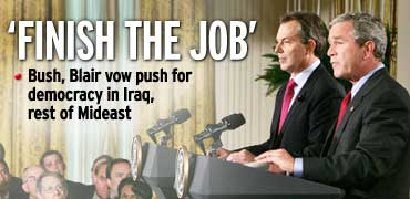
Nov. 12….(MSNBC) Wrapping up talks at the White House, President Bush and his main Iraq war ally, British Prime Minister Tony Blair, agreed Friday to "finish the job" of establishing a free Iraq and promoting democracy across the Middle East. That includes nurturing a democratic Palestine, President Bush told reporters at a joint news conference. The death of Yasser Arafat provides “a great chance to establish a Palestinian state” and a broader Middle East peace, Bush said. "I intend to use the next four years to spend the capital of the United States on such a state. (FOJ Note: the Presidents statement regarding a 2-state solution to the Israeli-Arab conflict will have dire consequences for America according to Zechariah 12:2-3) I believe it is in the interests of the world that such a truly free state develop. I know it is in the interest of the Palestinian people.” But Bush added that it was up to Palestinians to elect a democratic government and Arafat’s successors to allow freedoms to take root. “We’ll hold their feet to the fire to make sure that democracy prevails,” he said. On Iraq, Bush in his opening statement said violence could escalate further there as elections near, but he insisted the US coalition would prevail. "We'll continue to stand with our friends and we will finish the job," he said. Blair, for his part, said in his opening statement that "I have no doubt at all that we will overcome those difficulties" now facing coalition troops in Iraq. The leaders spoke shortly after Arafat was buried amid a chaotic scene in Ramallah. The Bush and Blair governments hope a change in Palestinian leadership might open new avenues toward peace. While President Bush coupled his call for a Palestinian state with his unwavering support of Israeli security, Blair stressed the need to bolster the Palestinians. “If we want a viable Palestinian state, we want to make sure the political, the economic and the security infrastructure of that state is shaped and comes into being,” Blair said. While the president didn’t commit to a Mideast conference or sending a US envoy to the region (two items sought by Europeans) he did talk more optimistically than usual about the prospects for a Palestinian state. Bush had earlier called the Palestinian chief’s passing an “opening” and Blair had said that creating a peaceful Palestinian state must be the international community’s highest priority. President Bush refused to work with Arafat, and the White House is hopeful that his successor can control violent groups and negotiate with Israeli Prime Minister Ariel Sharon, who is loathe to start talks amid violence. Blair is concerned about what happens in the post-Arafat era, said Julianne Smith, deputy director of the international security program at the Washington-based Center for Strategic and International Studies. “The worst-case scenario is that we just continue to have this muddle-through approach, focus strictly on Iraq and maintain the policy that the road to Jerusalem leads through Baghdad,” she said of foreign policy experts who believe that a democratic Iraq will foster peace throughout the Middle East. “Blair wants to change that. He wants to say let’s go back the Middle East peace process in terms of combating terrorism.” Two other key items on the discussion table were:
Arafat: A Dark Legacy is Over Nov. 12….Jan Markell Olive Tree Ministries, Inc. (www.olivetreeviews.org) Exactly ten years ago Yaser Arafat received the Nobel Peace Prize. Thankfully, today he exited the Middle East and world stage. While God has no pleasure in any man's death, the world is better off without the "godfather of terror." He has shed more blood than any other terrorist, and some Americans are among the victims. He was never been held accountable for those Americans that he killed. Be sure that much of the media will spin this story and paint Arafat as a "freedom fighter" who gave his life for the cause of a Palestinian state. He died one of the richest men in the world, having passed little of those riches on to the people who so admired him. His reign was not only brutal, it was also one of the most corrupt. Arafat was a survivor. In fact, he outlived four Israeli Prime Ministers but Ariel Sharon was delighted to say, "He didn't outlast me." World leaders will hail him as a great leader who pursued peace with stubborn Israel. He was, in fact, a pedophile and likely died of AIDS. A Mossad agent was planted in the Arafat administration and reports a sordid story not worth repeating. The world is now insisting that this is a "new opportunity for peace." The mantle will be passed on to a leader who wants peace, right? Wrong. That the days are now ripe for peace, or have ever been ripe for peace is one of the world's strongest delusions. The antichrist will use "peace issues" to take over the world some day. It would appear that President Bush sees this as a turning point in the "peace process." The Bible buried the "peace process" a long time ago. The Arab world, along with other parts of the world chiming in, follows Psalm 89: "Come, let us wipe out the memory of Israel's existence." This remains in the PLO Charter, though Arafat promised to remove it back in 1993. Credit goes to the president for not speaking to or doing business with Arafat, but will he see this as a new opportunity? It would appear likely that he will. Conservatives and Christians clearly did not re-elect the president to put the squeeze on Israel just days after the election. As White House correspondent Bill Koenig said on my radio show last weekend, November 6, when the president was informed of Arafat's passing, it appeared a great burden descended on him. He knew he was at a new fork in the road. In the press conference, Bush went from being light-hearted to great heaviness. The president would now have to re-start a process he was hoping he could bow out of. He may perceive more than we think but the pressure from the world is upon him. The State Department would sell out Israel in a heartbeat. Now more than ever, pray for our leaders. All the world must come against Israel. People often say to me that it will be all the world except America, but that's not what the Bible says in Zechariah 12. The consequences of going against God's land cannot be calculated. God is in control of all geo-politics. Much of it is foretold in the Bible for those who have ears to hear and eyes to see. You've been born "for such a time as this" which means you have the responsibility to not just watch events; you can shape them. To be indifferent to the issues of the day is not an option. Awaiting His return, Jan Markell
World Leaders Mourn Arafat Nov. 12….(FOJ) Making a mockery of genuine statesmanship,
world leaders today spoke glowingly of the Father of modern terrorism. It is a
sad state of affairs that the world would honor the father of terrorism, even as
they condemn America for waging its war on terror. French President Jacques
Chirac hailed Arafat as a man of courage and conviction who embodied the
Palestinian struggle for a state. "It is with emotion that I mourn at the
passing of President Yasser Arafat, the first elected president of the
Palestinian Authority," Chirac said in a written statement. "I offer my very
sincere condolences to his family and to people close to him." Chirac, who had
visited Arafat days before his death, called him a "man of courage and
conviction who, for 40 years, had incarnated the Palestinians' combat for
recognition of their national rights. On word of the death of Arafat, US
Secretary of State Colin Powell pledged that the United States "will do all we
can" to help Palestinians achieve peace and urged for calm to prevail in the
region. "Our concern remains for the Palestinian people and the realization of
the vision of an independent, democratic, viable Palestinian state, at peace
with its neighbors, as set forward by President Bush," Powell said. US President
George W. Bush's offered his condolences to the Palestinian people on the death
of Arafat. "The death of Yasser Arafat is a significant moment in Palestinian
history," Bush said in a statement issued by the White House. "During the period
of transition that is ahead, we urge all in the region and throughout the world
to join in helping make progress toward these goals and toward the ultimate goal
of peace." The State Department said that Israel must implement Prime Minister
Ariel Sharon's disengagement plan despite the death of Arafat. United Nations
Secretary-General Kofi Annan said that he was "deeply moved" by the death of
Palestinian Arafat and urged renewed efforts by the Palestinians and the
Israelis to reach peace. Anan also said Arafat would be remembered for
leading the Palestinians in a "giant step" toward peace in signing the Oslo
accords in 1993 and, "It is tragic that he did not live to see it fulfilled."
Annan expressed his condolences to Arafat's family and to the Palestinian
people. The European Union praised Arafat for his "single-minded commitment" to
the Palestinian cause and pledged to work with the new Palestinian leadership to
find peace in the Middle East. "We will work with the Palestinian authorities
and the international community to contribute to realizing the aspirations of
the Palestinian people," said a statement on behalf of the EU from Dutch Foreign
Minister Ben Bot. Javier Solana, the European Union's foreign policy chief, said
the "best tribute" to Arafat would be to renew efforts to implement the 2003
"road map" peace plan which envisions an end to violence and the creation of a
Palestinian state. British Prime Minister Tony Blair, in Washington for his
planned meeting with US President George W. Bush, said Arafat "led his people to
an historic acceptance and the need for a two-state solution. Russian President
Vladimir Putin praised Arafat as "an influential political figure on an
international scale." "It is a heavy loss for the Palestinian leadership, and
all Palestinians," Putin said in a statement released by the Kremlin. He
credited Arafat with "strengthening friendly relations between Russia and
Palestine." Russian Orthodox Patriarch Alexy II expressed condolences following
the death if Arafat, who he said "had waged a struggle for decades to uphold the
national interests of the Arab people of Palestine. The Vatican praised
Arafat as a leader who struggled to win independence for his people and repeated
its support of a sovereign Palestinian state alongside Israel. A Vatican
statement called Arafat an "illustrious deceased" and asked God to grant eternal
rest to his soul and peace to the Holy Land. Chinese President Hu Jintau said
Arafat's "death is not only a great loss for the Palestinian people, but the
Chinese people also lost a great friend." Former US President Bill Clinton
offered condolences to Palestinians but said their leader had missed the
opportunity to create lasting Middle East peace in 2000. In his statement
Clinton said, "I regret that in 2000 he missed the opportunity to bring that
nation into being and pray for the day when the dreams of the Palestinian people
for a state and a better life will be realized in a just and lasting peace."
Former US President Jimmy Carter called Arafat "the father of the modern
Palestinian nationalist movement" and "a powerful human symbol and forceful
advocate." Arafat’s Funeral Circus Parade November 12….(David Dolan) (www.ddolan.com) Deceased Palestinian leader Yasser Arafat was laid to rest in Ramallah amid a huge and emotional crowd. Palestinian policemen joined armed militiamen in firing hundreds of bullets into the air when the Egyptian helicopter carrying his body landed in Ramallah at 2:20pm (14:20 GMT). Fears that the huge crowd might spin totally out of control increased when hundreds of armed Fatah and Islamic militants scaled the Muqata compound walls to greet the arriving chopper. Attempts to remove the coffin from the helicopter was a chaotic scene as thousands pressed in to watch. When the coffin was finally removed after about 20 minutes, it was placed on a vehicle that had to ram its way through the massive crowd, many chanting “With blood and fire we will sacrifice ourselves, oh Abu Amar!!” (Arafat). The coffin, draped with the Palestinian flag, was then passed through the surging crowd toward its Muqata burial site. Intense security such as I have never seen remains in effect throughout Jerusalem this afternoon. Israel radio reported that the army and police forces were placed on a near-war footing this morning, in preparation for any eventuality. Fears centered on the possibility that hundreds of armed Al Aksa and Hamas gunmen at the funeral might try to march Arafat’s body toward the Temple Mount in Jerusalem, just a few miles south of Ramallah. While walking to a nearby hotel to do a television interview with Zola Levitt this morning, I was stopped for the first time ever and asked for my identity card or passport. Like many areas, the entrance to my street is being patrolled by six rifle-carrying soldiers, which is also unprecedented in my experience. Other than this, the holy city is actually fairly quiet as most local Arabs and Jews stay in their homes to watch the funeral live on television. Israeli Jews have been told to stay out of Arab neighborhoods, which most seem to be doing. Talking to many Israelis this morning, I discovered widespread disgust with the intense, often weepy international media coverage of Arafat’s passing and funeral over the past 24 hours, as if the Pope or a similar widely respected world leader had passed from the scene. Complaints were especially voiced over the international CNN (not the North American version) and BBC World Service coverage, which some felt bordered on idol worship. “Who do they think Arafat was, Ronald Reagan or John Kennedy?” asked one of my irate contacts.
Arafat Laid to Rest As West Bank Mourns Nov.12….(AP) Yasser Arafat was laid to rest in a marble-and-stone grave Friday after his flag-draped coffin was borne through a sea of emotional Palestinians who swarmed the helicopter that brought him from a state funeral in Egypt. Police fired wildly into the air to keep back the surging crowd at the West Bank compound known as the Muqata, where Arafat spent his last years as a virtual prisoner. After Arafat's body was lowered into the ground, Muslim clerics read Quranic verses and the late leader's bodyguards wept and embraced each other. Frantic mourners surged toward the tomb, trampling the olive tree saplings that were planted around the grave according to Islamic tradition. One policeman knelt on the marble and kissed the tombstone. Earlier, officials tried for 25 minutes to open the helicopter door to remove the coffin onto a jeep that had plowed through the crowd to clear a path. As the coffin was carried toward the gravesite, police jumped on top of it, waved their arms and flashed the victory sign. People chanted, "With our blood and our soul we will redeem you Yasser Arafat!" Stretchers carried away two people who were trampled in the melee. Mahmoud Abbas, the new head of the PLO, and Omar Suleiman, Egypt's director of intelligence, tried to emerge from the helicopter but were kept back by the huge, chaotic crowd. "President Arafat would have wanted it this way, with exhilaration, feelings of loyalty, pain, sadness and love all at once," Palestinian legislator Hanan Ashrawi told The Associated Press. "The people reclaimed him. They wanted to say goodbye without distance." Under the crush of screaming mourners, plans were hastily scrapped for a stately ceremony with Palestinian officials filing past his coffin. The red, white, green and black flag was ripped off the casket as it was carried through the crowd. The failure of police to control the pandemonium augured poorly for Palestinian hopes to maintain calm and order in the wake of Arafat's death. Hours earlier, mourners had burst through gates of the Muqata and climbed over the walls of the compound, thwarting attempts by armed police to hold them back. Police scrambled to keep them off the landing pad. As Arafat's helicopter touched down, the crowd cried out "Welcome, welcome Abu Ammar!" using his nom de guerre. "Welcome, welcome old man!" Buildings and windshields in the West Bank and Gaza were plastered with Arafat's photo and people waved black and white scarves, the colors of his Fatah movement. In Gaza City, hundreds gathered on rooftops, streets and apartment balconies in hopes of catching a glimpse of Arafat's helicopter. Barred from attending the burial, tens of thousands of Gaza residents held rallies and symbolic funerals across the strip. Teenage boys climbed onto the walls of the compound chanting, "Whoever poisoned Arafat, we will drink his blood." Others cried out, "Allahu akbar," Arabic for "God is great," and "We want to see Abu Ammar." Top Arafat aide Tayeb Abdel Rahim emerged from the compound and asked the crowd to stop chanting. "The whole world is watching us now on television and we have to reflect our real picture," he said. Egypt gave Arafat a state funeral in Cairo, even though he never realized his dream of Palestinian statehood. The service began amid heavy security with humble prayers at a mosque in a military compound and ended with a procession, his flag-draped wooden casket set on a horse-drawn gun carriage and followed by a crowd of presidents and kings. Egyptian President Hosni Mubarak, Saudi Crown Prince Abdullah as well as Abbas and Farouk Kaddoumi, the newly chosen leader of the Fatah organization, were among the dignitaries who marched behind the casket on a residential street a short distance toward a military airfield. Doors and shutters of homes along the route were closed, and the street was cut off to the public. Arafat's veiled widow, Suha, and their rarely seen 9-year-old daughter, Zahwa, wept as the Palestinian and Egyptian national anthems were played by a band before the casket was loaded aboard an Egyptian military plane. The jet flew to el-Arish, in Egypt's northeastern Sinai Peninsula, where the casket was transferred to the helicopter. Among the dignitaries who attended the Cairo ceremony were Syrian President Bashar Assad, Sultan Hasanal Bolkiah of Brunei, South African President Thabo Mbeki, European Union Foreign Policy chief Javier Solana and Pope Shenouda III, head of Egypt's Coptic Orthodox Church. The United States, which had labeled Arafat an obstacle to peace, sent Assistant Secretary of State William Burns. Israel sent no delegation.
Vatican praises Arafat for Palestinian vision Nov. 12….(Zenit News) The Vatican has praised Yasser Arafat as a charismatic leader who struggled to win independence for his people, and repeated its support of a sovereign Palestinian state alongside Israel. Pope John Paul, who last met Arafat in 2001, retreated into private prayer when he was told of the death of the Palestinian leader earlier on Thursday in Paris, a Vatican source said. The Pope, who made a historic trip to Israel and the Palestinian territories in 2000, sent a message saying he was particularly close to the Palestinian people "in this hour of sadness". The 84-year-old Pope's message said he prayed that the "star of harmony" would soon bring peace to the Holy Land and that both Israelis and Palestinians could live "reconciled among themselves as two independent and sovereign states". Earlier, a statement by the Vatican's chief spokesman called Mr Arafat the "illustrious deceased" and asked God to grant eternal rest to his soul. "The Holy See joins the pain of the Palestinian people for the passing of President Yasser Arafat. He was a leader of great charisma who loved his people and tried to guide them towards national independence," said the statement by chief spokesman Joaquin Navarro-Valls. The official statement was bound to displease Israel because it made no mention of militant attacks, which the Jewish state blamed on Mr. Arafat and insists must stop before the stalled peace process can get back on track. In recent years the Vatican continued to recognize Arafat as the legitimate leader of the Palestinians after Washington and Israel had written him off. But Vatican officials privately criticized him for what one called "jumping off the peace train". "There is no doubt that he was a towering figure for his people but his great mistake was not to sign on at Camp David," a senior Vatican prelate told Reuters. "That was a great failure and a lot of problems stemmed from that," he said. "He missed his date with history." At a US-brokered a peace summit in 2000 both sides came close to a final accord that would have established an independent Palestinian state, but the talks broke down over the status of Jerusalem and Palestinian refugees. Washington and Israel blamed Arafat for the failure. Over the past four years, the Vatican's improvement in relations with the Palestinian Authority coincided with a deterioration of relations with Israel. The Pope repeatedly criticized Israeli incursions into Palestinian territories and last November, the Vatican conveyed its shock when Israeli Prime Minister Ariel Sharon came to Rome for several days but did not ask to see the Pope. Pope, Vatican Mourn Arafat
World Council of Churches Praises Arafat Nov. 12….(Assist News) In a move expected to raise controversy, the World Council of Churches (WCC) expressed its condolences Thursday, November 11, to the Palestinians following the death of Yasser Arafat at age 75, earlier in the day. Although Israeli government officials and some of their Christian supporters in Jerusalem criticized Arafat for his alleged links to terrorist networks, a WCC official described him as someone who should be honored for upholding the place of both Christians and Muslims in Palestinian society, as "participants in its affairs and as shapers of its future. In a letter sent to the Palestinian Prime Minister Ahmad Qurei', the director of WCC's International Affairs Commission, Peter Weiderud, said his Geneva based organization believes "President Arafat will be remembered for bringing the Palestinian people together and for his unique and tenacious contribution to the cause of establishing their national home." The official stressed the WCC, the "largest inter-church body in the world" will "ask God's comfort for the members of his family in this time of deep grief." Weiderud said "the WCC Churches of the Holy Land" honor Arafat's "commitment to their place in the Palestinian society" and he lashed out to Israel's "occupation" of Palestinian territories. "His path has now ended, amid the rocks and thorns of occupation, at a distance from the goal he sought. As he is laid to rest the world will see, from the location of his final resting place, how far the Palestinian people must still travel together,” he added. Arafat "came to the recognition that true justice embraces peace, security and hope for both Palestinians and Israelis," he added. Weiderud's words on behalf of an organization representing hundreds of churches in over 120 countries, were not supported by everyone in Jerusalem. FOJ Note: The WCC does not represent the true Church of Jesus Christ. Rather, they represent the agenda of the coming Antichrist.
Arafat & Chirac-Long time Pals Nov. 12….(FOJ) French President Jacques Chirac has quite a long history of befriending international terrorists. He was a close pal of Saddam Hussein, and labored tirelessly to keep Saddam in power in Iraq. Last week, hetold Yasser Arafat; France "will always stand with you in the search for a just and durable solution to the Middle East conflict,” and extended Arafat a welcome to Paris for medical needs.
UN Lowers its Flag to half-mast for Arafat 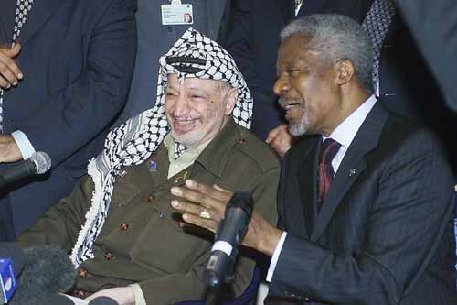
Nov. 12….(World Net Daily) While Yasser Arafat is being remembered by many as the father of modern terrorism, the United Nations headquarters in New York City is honoring the Palestinian leader by lowering its flag to half mast. "Deeply moved" by news of his death, UN General Secretary Kofi Annan gave Arafat a "special tribute" before the General Assembly this afternoon after conveying condolences to his wife and daughter. "By signing the Oslo accords in 1993 he took a giant step towards the realization of his vision of statehood and peace" Annan said in a statement delivered by a spokesman. "It is tragic that he did not live to see it fulfilled." Arafat’s Billions Causing Strife in his Death Nov. 10….(FOJ) In his four decades as Palestinian leader, Yasser Arafat has run a murky financial empire that includes far-flung PLO investments in airlines, banana plantations and high-tech companies, and money hidden in bank accounts across the globe. Jaweed al-Ghussein, a former PLO finance minister, told The Associated Press it was worth $3 billion to $5 billion when he quit in 1996. No one will say how much it's worth now, some estimates say as little as a few million. But as 75-year-old Arafat fights for life in a hospital near Paris, Palestinians fear that what's left will disappear or be pocketed by Arafat cronies. "It's the money of the Palestinian people," said Palestinian legislator Hassan Khreishe, adding that he would urge a parliamentary investigation. That could prove difficult. Arafat has long resisted proper accounting for the funds, which include Arab payments to the PLO in the 1970s and 1980s, and Western aid to his self-rule government, the Palestinian Authority, after interim peace deals with Israel in the 1990s. Arafat lived frugally, but needed large sums to maintain loyalties. He would register investments and bank accounts in the names of loyalists, both to buy their support and protect the holdings from scrutiny and seizure, said al-Ghussein. Only Arafat had the full picture, he said, and it's not clear whether he left a will or financial records. Arafat never divulged his finances. Pressed at a February meeting with leaders of his Fatah movement, he cut them short, saying "there are no assets," according to one participant. Mohammed Rashid, Arafat's financial adviser, denied his boss was rich. "Arafat has no personal property in any part in the world," he told Al-Arabiya television on Sunday. "He doesn't even have a tent, a house, an orchard or any account that we can call personal in the name of Yasser Arafat." However, Forbes magazine ranked him No. 6 on its 2003 list of the richest "kings, queens and despots," estimating he was worth at least $300 million. Shalom Harari, a former top Israeli intelligence official, said Arafat may have stashed away up to $700 million, part of it for an emergency such as a new exile, especially with Israel threatening to expel him. Two names frequently come up in connection with Arafat's money, Rashid and Arafat's wife, Suha. In the past 10 years, Rashid has handled hundreds of millions of dollars in Palestinian Authority revenue Arafat diverted from the treasury, though a reformist finance minister, Salam Fayyad, said the money was invested on behalf of the Palestinian Authority and has since been restored to public control. Suha Arafat, Arafat's wife of 13 years and mother of his daughter, lives in Paris and has received monthly payments of $100,000 from the Palestinian coffers, according to a senior official in Arafat's office. This year, French prosecutors launched a money-laundering probe into transfers of $11.4 million into her accounts. She has refused to talk to reporters about Palestinian finances. Al-Ghussein, speaking by telephone from London, said the big money from the Arab world started flowing in 1979. For a decade, the PLO received about $200 million a year, $85 million of it from Saudi Arabia, he said. Al-Ghussein, who headed the Palestinian National Fund, the PLO treasury, said during that period, he would hand Arafat a check for $10.25 million every month from the PLO budget, ostensibly for payments to PLO fighters and families of those killed in battle. He said Arafat refused to account for his spending, citing national security. Much of the Arab money dried up after Arafat infuriated his patrons in 1990 by siding with Saddam Hussein during Iraq's invasion of Kuwait. But Saddam Hussein gave Arafat $150 million in three payments, Al-Ghussein said. "It was handed to Arafat personally," said al-Ghussein, who left his job in 1996 after falling out with Arafat. In 2000, a court in the United Arab Emirates, where al-Ghussein lived at the time, cleared him of stealing $6.5 million in Palestinian Authority funds. The PLO investments are said to have ranged from an airline in the Maldives to a Greek shipping company, banana plantations, a diamond mine in Africa and real estate throughout the Arab world. The holdings were registered in the names of dozens of Arafat loyalists, according to a retired PLO financier in Gaza and to a Palestinian economist in the West Bank who began following the money trail at the request of some Fatah officials this year. Both spoke on condition of anonymity. A senior Palestinian Authority official with detailed knowledge of financial transactions said much of the money has been lost. Some of the companies went bankrupt. In other cases, Arafat cronies absconded with the cash. Some frontmen for PLO investments died, and the holdings passed to their families. Others insisted the PLO still has substantial assets. Al-Ghussein said that when he left office the money was in "numerous accounts" worldwide, but he declined to elaborate. The West Bank economist estimated the organization had $2.5 billion to $4 billion in assets and cash. Suha Arafat’s French lawyers and former Palestinian Prime Minister Mahmoud Abbas (Abu Mazen), have struck a deal on dividing up Arafat’s wealth however. It fixes the Palestinian Authority’s financial obligations to Yasser Arafat’s widow and lets Arafat finally die unambiguously the end of the current morbid tug of war between his wife and Palestinian Authority leaders. The confusion surrounding Arafat’s condition for eleven days, officially alive, then unofficially dead, was a ruse while the PA and Suha argued over money. The settlement will allow a funeral to be arranged, perhaps on “Orphan Friday” of Ramadan, November 12, unless a new crisis pops up. Last July, Arafat sent his wife $11 million to cover His wife’s living expenses and those of their daughter for six month, $1.8 million per month. The new death-accord guarantees her the same allowance from the Palestinian Authority as a regular annual remittance, i.e. $22 million per annum, for the rest of her life. Abu Mazen and prime minister Ahmed Qureia (Abu Ala) signed on the dotted line, although they have no notion how the penniless Palestinian Authority faced with a people in dire poverty can possibly stump up this kind of money. There is much concern in the PA camp that Suha Arafat, may not have truly converted to Islam when she married the Palestinian leader, an issue that could be a major factor in the controversy surrounding the execution of his will and distribution of his fortune. Suha was a 27-year-old Christian at the time she married 61-year-old Yasser Arafat in 1990. Although she ostensibly converted to Islam in 1990, that conversion appears to be somewhat in doubt. Israeli sources say Suha hopes to delay as long as possible the announcement of her husband's death to bide time while she tries to negotiate for herself a large inheritance. The validity of her conversion to Islam comes into play when considering Islamic law regarding inheritance and may in fact be at the foundation of the melodrama being acted out in Paris. Suha requested her husband last week draft a will leaving his multimillion dollar fortune to her, but Arafat refused. In the case of Arafat, both of his parents are dead; and he has no son. Arafat's living heirs are his wif, Suha, his daughter and his brother, Dr. Fathi Arafat. Fathi Arafat is currently being treated in a Cairo hospital for terminal cancer; if Fathi Arafat dies first, then his heirs will not stand to inherit from Yasser Arafat. Only if Yasser Arafat predeceases Fathi Arafat will Fathi's family stand to inherit part of their uncle's estate through their father. Of the original seven Arafat children, only Fathi and Yasser are still alive; their sister Yusra died last year; another sister, Inam, is buried in the Khan Younis refugee camp. Another brother is buried in Gaza.
Arafat’s Financial Empire in Jeopardy Nov. 10….(Fox News) A new source of income opened for Arafat
after he established limited self-rule in parts of the West Bank and Gaza. The
international community, protective of the fledgling peace effort with Israel,
donated more than $6.5 billion to the Palestinian Authority from 1994 to 2003,
in the beginning with few questions asked.
US Reaches Out to EU on Mideast Peace After Arafat Nov. 10….(My Way) The Bush administration is reaching out to European allies for a possible new push for peace in the Middle East if Palestinian leader Yasser Arafat is replaced by more moderate leaders, US and diplomatic sources said on Monday. A senior Bush administration official said US and EU officials met on Friday at the White House to discuss efforts to revive the "road map" peace plan and how the death of Arafat, who is critically ill in a French military hospital, would change "the realities in the region." White House officials played down the session, which was not made public until Monday. But diplomatic sources said it was a sign of growing trans-Atlantic coordination, which has been marred in the past by differences over whether to negotiate with Arafat. The United States has long pressed European governments to sideline the Palestinian leader, whom Israel and Washington accuses of fomenting anti-Israel violence, an allegation he denies. Friday's meeting was attended by French, German, British and other European Union officials and came one day after President Bush promised to push in a second term to revive Middle East peace talks. One diplomatic source called it a "brain-storming" session to "coordinate and exchange views," adding, "there was no conclusion." But the road map is expected to be a major focus of talks this week between Bush and British Prime Minister Tony Blair, who has been prodding his American ally to make the Middle East peace process a higher priority. "If Arafat dies, there will be new realities in the Middle East and it is incumbent on the United States to recognize and be prepared to respond to those new realities," a senior Bush administration official said. Officials said Washington's response would depend on who takes over for Arafat. General elections for president of the Palestinian Authority would be held 60 days after Arafat's death according to Palestinian law. The Bush administration has also signaled a willingness to increase US economic ties with the Palestinian Authority once leaders it sees as more accountable are in place.
Egypt Agrees to Host An Arafat Funeral Nov. 10….(Reuters) Egypt has agreed to host a funeral in
Cairo for Palestinian President Yasser Arafat, who is in a Paris hospital where
he suffered a brain hemorrhage, Egyptian and Palestinian officials said.
Palestinian officials have insisted in public that Arafat is alive but aides
said privately he was dead. He is believed to have been born in Cairo although
he insists he was born in Jerusalem. "We will hold the funeral in Egypt and
after that we will take President Arafat, after his long life, to Ramallah,"
Egyptian presidential spokesman Maged Abdel-Fatah told reporters. He said
detailed arrangements had not been completed, adding he hoped for "a miracle" so
the plans would not be needed. A security official said the funeral would be
held at Cairo airport when the body arrived from Paris. He said prayers and
military ceremonies would take place before the body was taken to Ramallah, via
Jordan, for burial. Israel Radio said the Israeli government had agreed Arafat
could be buried in the West Bank city. WEEK OF NOVEMBER 1 THROUGH NOVEMBER 7
With Bush Reelected, Where does Prophecy lead Now? Nov. 5….(FOJ) ( www.focusonjerusalem.com ) With the reelection of George W. Bush as the President of the United States, this ministry is being besieged with questions about the prophetic implications of Bush’s re-instatement as president for another four years. The office of the US Presidency is usually touted by political commentators as being the most powerful position in the world, so the occupancy of the White House always leads to speculation about where we stand in end-time events. Scholars of Bible prophecy always have a difficult time pinpointing the role of the US in end-time events, and while the Bible is silent on any clear and direct association of the US in prophecy, that does not mean that our North American homeland is not included in Bible prophecy. The Bible says that all nations of the Last Days era will be gathered together against Israel. If the United States is able to retain its political sovereignty and identity to the end of the Tribulation era, then that means the US will be aligned with the forces of the Antichrist. (Joel 3:2 I will also gather all nations, and will bring them down into the valley of Jehoshaphat, and will plead with them there for my people and for my heritage Israel, whom they have scattered among the nations, and parted my land.) But, before that climactic day, America will be hard hit by the Rapture event, providing a unique opportunity for the liberal socialists in the US political arena to finally form a trans-Atlantic coalition with their Globalist ideologues of the burgeoning European Union. This Western-Roman geo-political entity will form the basis of the empire of the Antichrist. But where do we stand in prophecy until then, especially now with the election of a conservative, pro-American, and astute Christian and moral leader that is President Bush?
The election of President Bush is a good thing, but it is not everything America needs. America would not be in the sad and desperate condition that she is in today had it not first been for the fact that our spiritual leadership and our Churches first abandoned their duty of being the shining light set on a hill. America needs a spiritual re-awakening, and the time for repentance nationally is quickly elapsing in God’s permissive will for these Last Days. (Matthew 5:14 Ye are the light of the world. A city that is set on an hill cannot be hid.) David Dolan Reporting that Yasser Arafat is Dead Nov. 4 Bulletin: 2:00pm EST….(David Dolan) ( www.ddolan.com/ ) Israeli Security sources have just informed me that they have been solid indications that YASSER ARAFAT has passed away. I want to stress that these are as yet unconfirmed security reports. Israeli media reports say military forces have been placed on full alert, ready to move into Palestinian areas at the first sign of trouble if indeed the Palestinian leader has passed away. Israeli Defense Minister Shaul Mofaz is meeting in emergency session with senior security officials in Tel Aviv to discuss the reported severe deterioration of Yasser Arafat’s health in the past few hours. The Palestinian leader was rushed to intensive care in a hospital in France overnight. Reports reaching Jerusalem, broadcast on Israel radio, say the Palestinian leader has slipped into a coma once again. A news conference by his doctor’s, scheduled for this morning, has been abruptly cancelled, leading to speculation that Arafat may be at death’s door. Palestinian officials, who have confirmed that their leader is gravely ill, are also now meeting in emergency session in Ramallah. According to press reports, Arafat stopped breathing for a time overnight, along with other signs of possible imminent death. Israeli leaders are reportedly concerned that if Arafat passes away in the next 24 hours, there could be significant unrest in the Palestinian areas on the last Friday of Ramadan—always an emotional time for Middle East Muslims anyway. Police and army forces are expected to be significantly beefed up to deal with any possible backlash, especially around Jerusalem. The number of Arab Muslim allowed up on the Old City’s Temple Mount for Friday prayers is now expected to be severely limited. Government officials are said to be especially concerned over unfounded rumors swirling around the territories that Israeli agents might have poisoned the veteran PLO leader. Arafat’s doctors earlier denied that any poison has been discovered in his body. There is also said to be widespread Palestinian anger over recent reports in the Israeli media that quote a homosexual web site which suggests that Arafat might be suffering from AIDS. The reports maintain he may contracted the disease during sexual encounters with some of his male bodyguards. Israeli security agents have long been said to possess concrete evidence of Arafat’s alleged illicit homosexual activities. Other rumors that have circulated in the region for several years claim that Arafat’s ten year old daughter is actually the result of an affair between his wife Suha and now-jailed Fatah official Marwan Bargouti. All of this is expected to add to tensions expected when the veteran Palestinian leader finally dies.Bin Laden’s Decapitation Strike Attempt Nov. 4….(FOJ) Now that the election is over, and George W, Bush has been reelected as President, one must ponder about what Osama bin Laden said in his October Surprise video. It was in essence a terrorist psychological ploy for a decapitation strike against the leader of the war on terror! Bin laden warned that he will be closely monitoring the state-by-state election returns in America’s presidential race, and will spare any state that votes against President Bush from being attacked. The Middle East Media Research Institute, which monitors and translates Arabic media and Internet sites highlighted an ostentatious bid by the Saudi-born terror master to divide American voters and tilt the election towards Democratic challenger John Kerry. MEMRI interpreted the key passage of bin Laden's diatribe to mean that any US state that votes to elect Bush on election day will be considered an "enemy" and any state that votes for Kerry has "chosen to make peace with us." Bin Laden said, "Your security is up to you, and any state that does not toy with our security automatically guarantees its own security." That sentence followed a lengthy passage in the video in which bin Laden launches personal attacks on the president. America’s reelection of President Bush should serve notice to Bin Laden, and terrorists world-wide that America doesn’t take threats lying down. On the other hand, we here in America that voted in Red-Bush states should likewise realize that we (conservative, moral values, fundamentalist Christians) are the actual targets of the terrorists. In their own words, we are the infidels that they despise and are encouraged by Allah to kill. Thus, we need to pray for national revival and to pray for God’s hedge of protection to be preserved.
Hilary Clinton next for Democrats? Nov. 4….(FOJ) Even as President Bush was declaring victory and John Kerry conceded defeat yesterday, news agencies in the US and around the world began splashing the name of Hilary Clinton as the future of the Democratic Party. While the senator from New York has not made any new comment regarding the next presidential election cycle, it is widely believed she will seek the White House. Senator Clinton has that some people were disappointed that he wasn't a 2004 candidate, and has all but hinted that she might consider a run for the presidency in 2008. "Well, perhaps I'll do it next time around," she said recently. "Hillary Clinton is the natural heir apparent" of Bill, said Allan Lichtman, a political science professor at American University in Washington, according to Agence France-Presse. "Two well-placed GOP insiders say it's 'basically a done deal,'" wrote John Ellis, a partner in a venture capital firm in New York City and first cousin to Florida Gov. Jeb Bush. The national major news media did all it could possibly do to help John Kerry unseat the President, but if you think they were obvious in their schemes this time around, you just wait until the next presidential election. When their prime time liberal hero Hillary throws her cookies into the ring, they will stop at nothing to glorify her campaign. Husband Bill Clinton is said to aspire the UN Secretary General’s office, but that option may have gone by the wayside, at least temporarily, when American’s voted George W. Bush back into office. The US President must approve the candidacy of any American that runs for UN office, so the New World Order and the Global Governance agenda of the Secularist Democrats may have been put on a slower than anticipated track.
Arafat Said to be in A Coma Nov. 4….(Maariv) Yasser Arafat has lapsed into a coma in a French hospital, a senior Palestinian official said Thursday, a day after the Palestinian leader was rushed to intensive care following a sharp deterioration in his health. The official would not say when Arafat lost consciousness. Two Arafat aides denied he was in a coma, but the senior Palestinian with close access to the medical team insisted Arafat was comatose. French hospital officials would not comment on the ailing Arafat's health. The 75-year-old leader was rushed for emergency treatment to the Percy Military Training Hospital outside Paris on Friday. Since then, his condition has largely remained a mystery, with Palestinians issuing conflicting reports about his health. Israeli media, citing Israeli intelligence officials, said Arafat suffered organ failure and had lost consciousness several times. The Maariv daily said Arafat's condition was "very critical." Speculation in Israel on Arafat's condition has ranged from a viral infection to stomach cancer. Cabinet official Saeb Erekat called reports Arafat had lapsed into a coma "baseless." Erekat told The Associated Press that Arafat's wife, Suha, told him Arafat's condition was "stable but difficult." Mohammed Rashid, Arafat's financial adviser, also denied reports that Arafat had slipped into a coma. "Last night, several blood and bone marrow tests were done that required the president to be in an isolation unit for several hours, and there is no truth to any of the reports that he is in a coma," Rashid said. Earlier Thursday, Palestinian officials said Arafat had lost consciousness repeatedly and described his condition as extremely serious. The Israeli military was placed on high alert and was following developments with Arafat closely, Israeli security sources said. The Israeli army has a contingency plan, called "new leaf," to deal with the fallout from Arafat's death, including possible Palestinian riots. In the West Bank city of Ramallah, senior Palestinian officials convened an emergency meeting after learning of the deterioration in Arafat's condition, said Sakher Habash, a member of the Central Committee of the ruling Fatah movement. Arafat's condition deteriorated sharply Wednesday and he was rushed into intensive care. Doctors still do not know the cause of the blood and digestive disorders uncovered over the past few days. Israel Radio reported that Mahmoud Abbas, No. 2 in the hierarchy of Arafat's Palestine Liberation Organization and his first prime minister, was on his way Thursday morning to Paris to see him. Arafat's top aides have denied there was any setback and accused Israel of spreading rumors. The report first aired on Israel's Channel Two television. "These unfounded reports are not coming from French medical teams, these are leaks from the Israeli side," Mohammed Dahlan, a former Palestinian security chief, said in Paris. "Leaking such rumors will only complicate things and also complicate the situation within the Palestinian public." PA officials, undoubtedly conscious of the anxiety back home at the thought of a future without Arafat, who has led the Palestinians for 40 years with no obvious successor, previously have described his condition as improving and said more tests were being done. Khaled Salem, Arafat's top aide, said early Thursday the medical analysis was "deepening a little bit" but he remained confident Arafat would recover. However, top Israeli security officials were meeting Thursday to study the repercussions in the Middle East should Arafat die, Israeli officials said on condition of anonymity. The security officials, including Israeli Defense Minister Shaul Mofaz and Army Chief Lt. Gen. Moshe Yaalon, were to focus their weekly meeting on reports that Arafat's health took a sudden turn for the worse, the officials said. Arafat's brother, Fathi, has had stomach cancer for four years and is currently hospitalized in Cairo, Egypt, with an advanced stage, according to doctors there.
For Bush, Iran Will Be Leading Issue Nov. 4….(MENL) President George Bush was expected to make Iran his leading foreign policy concern during any second term in office. Officials said the White House and other departments in the administration have already discussed U.S. options to halt or delay Iranian nuclear weapons production. They said the options would be examined and developed during 2005. "The president knows about Iran and is worried about Iran, but has set aside this issue for his second term," an official said. "By next year, it will clearly be a leading national security issue." US Does Have Real Allies in the World Nov.3….(FOJ) In a rather dramatic statement from Moscow, Russia’s President Putin said victory for Bush meant that the United States had not allowed itself to be cowed by terrorists. (like Spain) "I can only feel joy that the American people did not allow itself to be intimidated, and that they made the most sensible decision," he told a Kremlin news conference. Italy’s Berlusconi, also in Moscow, said: "President Bush will continue with the policy that assigns the United States the role of defender and promoter of freedom and democracy." In Poland, which like Italy has troops in Iraq backing US forces, President Aleksander Kwasniewski said that on terrorism Bush "is a very decisive leader who is right, simply right" and that continued cooperation with him was "really good news." Iyad Allawi, prime minister of the new US-backed Iraqi government, said, "The United States liberated us from a dictator (Saddam Hussein) and from a very long period of war and agony.
Eleven States Overwhelmingly Ban Gay Marriage Nov. 3….(Weekend News) In a resounding, coast-to-coast rejection of gay marriage, voters in 11 states approved constitutional amendments Tuesday limiting marriage to one man and one woman. That's ALL the states that had it on the ballot yesterday. The amendments won, often by huge margins, in Arkansas, Georgia, Kentucky, Michigan, Mississippi, Montana, North Dakota, Oklahoma, Ohio, Utah and Oregon, the one state where gay-rights activists hoped to prevail. The bans won by a 3-to-1 margin in Kentucky, Georgia and Arkansas, 3-to-2 in Ohio, and 6-to-1 in Mississippi. "This issue does not deeply divide America,"(as the liberal left has constantly claimed on tv) said conservative activist Gary Bauer. "The country overwhelmingly rejects same-sex marriage, and our hope is that both politicians and activist judges will read these results and take them to heart." Gay rights leaders were of course dismayed by the results but declared that their struggle for marriage equality would continue unabated. Fundamental human rights (??) should never be put up for a popular vote," said Matt Foreman of the National Gay and Lesbian Task Force. "We'll win some states and we'll lose some states, but eventually the Supreme Court is going to look at the Bill of Rights and isn't going to give a damn what's in any of these state constitutions." In Georgia, Ohio and Mississippi, gay-rights activists were considering court challenges of the newly approved amendments. But supporters of the bans were jubilant. "I've said all along that this crossed party lines, color lines and socio-economic lines," said Sadie Fields of the Georgia Christian Coalition. "The people in this state realized that we're talking about the future of our country here." Conservatives had expected for weeks that the amendments would prevail in at least 10 of the states, thus demonstrating widespread public disapproval of the Massachusetts court ruling a year ago that legalized gay marriage there. (even tho' the people didn't want it) The amendments in Mississippi, Montana and Oregon refer only to marriage, specifying that it should be limited to unions of one man and one woman. The measures in Arkansas, Georgia, Kentucky, Michigan, North Dakota, Ohio, Oklahoma and Utah call for a ban on civil unions as well. The Ohio measure, considered the broadest of the 11 because it barred any legal status that "intends to approximate marriage," gathered equal support from men and women, blacks and whites. Already this year, voters in Missouri and Louisiana have weighed in on the issue, with gay-marriage-ban amendments winning more than 70% of the vote in both states. But sadly Louisiana's amendment was later struck down in state court on the grounds that it improperly dealt with more than one subject by banning not only same-sex marriage but also any legal recognition of common-law relationships, domestic partnerships and civil unions. The court challenge in Georgia involves a similar argument. (As said by congressmen on the news, the courts are illegally legislating their own views from the bench.) Conservatives say they will continue to press for a federal constitutional amendment banning gay marriage, on the premise that even toughly worded bans in state constitutions could be overturned by a liberal US Supreme Court. Bush Reclaims US Presidency 
Nov. 3….(AP) After considering a challenge to the result
in Ohio, Sen. John Kerry has conceded the presidential election to President
Bush. The Massachusetts Democrat telephoned Bush and will make an announcement
at 1 p.m. Eastern in Boston. The president is scheduled to speak two hours
later.
Israel Relieved With Bush Victory Nov. 3….(David Dolan) ( www.ddolan.com) Israeli political pundits say the country’s leaders are heaving a quiet sigh of relief today after the apparent Bush-Cheney victory in the close US presidential election. For Ariel Sharon, the result reinforces his contention that his proposed evacuation of 25 Jewish communities in the Gaza Strip and northern Samaria will be enough to satisfy the Americans that Israel is carrying out its part of the Road Map peace plan. However, Sharon’s supporters acknowledge this may change if a “responsible” Palestinian leadership emerges when Yasser Arafat finally passes from the scene, or is otherwise removed from power. Meanwhile a senior aid to the Palestinian leader expressed regret today over Bush’s seeming triumph, saying the Middle East would have been better off if a new man had occupied the White House. More importantly for Israeli political and military leaders, the US election result virtually guarantees that the small Jewish State will have the full backing of its main international ally if the government orders its military forces to remove the menacing Hizbullah missile threat from Israel’s northern border. Such action, which many expect to come before the Gaza withdrawal next year, could easily spark a clash with Hizbullah’s Syrian masters, if not with the radical Shiite militia’s main regional backer, Iran. If so, Sharon is now assured that the US would likely come to Israel’s aid if necessary, which many felt was not a certainty if the liberal “internationalist” Senator had become Commander in Chief. A related issue is Iran’s threatening nuclear program. Israeli leaders are said to believe that George W. Bush is much more likely than John Kerry to order US forces into action if he becomes convinced that the extremist Muslim country is about to deploy nuclear weapons in the next four years. Indeed, they noted that Bush basically said as much in a Fox News interview with Bill O’Reilly, broadcast in the US and Israel on Monday. Israeli leaders consider Iran to be by far their most threatening regional enemy. Government leaders have also hinted that they trust Bush far more than Kerry to pursue the war against Islamic terror groups and states that support them. They were less than convinced that the Massachusetts Democratic candidate would vigorously carry on this “necessary struggle.” Many senior government and security officials questioned some aspects of the US-led war against Saddam Hussein, especially the stated expectations that most Iraqis would enthusiastically welcome Western military forces, and that a functioning democracy was likely to rapidly emerge in Iraq. Still most are said to think Bush is the best man at the helm as US troops enter the looming battle over Fallujah, which many expect to be a pivotal campaign that will probably determine the future of the fractured country of Iraq, located just 300 miles east of Israel.
Powell to ElBaradei: Steer Clear of “Our” Election Nov. 3….(Fox News) The United Nations’ chief weapons inspector has called US Secretary of State Colin Powell to complain about the impression some had that he was trying to influence the American presidential election. But Powell told Mohamed ElBaradei, the head of the International Atomic Energy Agency, to steer clear of the election and to stop talking to the press about 377 tons of explosives the IAEA said last week was missing from an Iraqi facility, a US official told Fox News. The two men had a telephone conversation Friday after ElBaradei was questioned by Fox News’ Jonathan Hunt. ElBaradei told Hunt he was “absolutely not” trying to influence the election. Hunt caught up with ElBaradei again Monday. But the IAEA head said he wound not comment on a private conversation with Powell. ElBaradei repeated that it was unfortunate that the missing explosives report had become part of the political debate but there was nothing the IAEA could do about that. “There is a world outside the US election," he said, adding that matters need to be addressed whatever is going on in US politics. State Department officials Monday said they have not mounted an active campaign to prevent ElBaradei having a third term as the IAEA’s director general. However, the diplomatic agency's spokesman said the United States endorses a two-term limit for UN positions. “The issue of a third term, should it present itself, is something we'd have to look at when it becomes an issue,” said deputy spokesman Adam Ereli, adding that the department respects ElBaradei and does not consider its position on third terms as a personal one against the UN's chief weapons inspector. “Obviously, we've worked very, very closely and very productively on a number of issues of concern to the international community. ElBaredei made a report to the U.N. Security Council on the matter on Oct. 25. Before the US-led invasion of Iraq in March of 2003, ElBaradei and his UN colleague Hans Blix took few pains to disguise their anger at the Bush administration for its perceived impatience with the weapons inspections process. In turn, Washington accused ElBaradei of working sluggishly in Iraq when he failed to turn up nuclear material. The last time the IAEA knew with certainty the contents of the Al-Qaqaa bunkers was in January of 2003, when its inspectors logged all the explosives there. The IAEA action report, which was obtained by Fox News, placed the inventory of HMX and RDX explosives at Al-Qaqaa at 221 tons, not 377 tons, as the IAEA reported Monday. The IAEA believes the explosives were taken, possibly by looters or terrorists, after Saddam Hussein was driven from power, but US officials maintain the explosives were already gone before US troops arrived at Al-Qaqaa shortly before Saddam's defeat. The Bush administration may have recently gotten support for their claim. Maj. Austin Pearson on Friday announced that a team from his 3rd Infantry Division had destroyed about 250 tons of munitions and other material from the Al-Qaqaa facility after the fall of Baghdad in April 2003.
World Watched Intently As US Voted Nov. 3….(My Way) People outside the United States could only
watch, wait and vent as Americans voted Tuesday in an election that provoked an
extraordinary degree of emotional involvement beyond US borders. Not just
leaders and news media, but ordinary people were riveted by the contest between
President Bush and John Kerry, convinced that a world roiled by the US-led
occupation of Iraq, the war on terrorism, and cultural and religious conflict
had a huge stake in the outcome. Saif-ur Rahman, a 36-year-old lawyer in
Pakistan's capital, Islamabad, planned to watch the results come in and hoped
for a change. "Muslims have suffered under Bush whether they are in America or
elsewhere," he said. "I hope Kerry will change that." In Sao Paulo, Brazil,
Wagner Markues, 54, also preferred Kerry and wondered why the race was so close.
"We don't understand America now," he said. "Are they getting different
news than us about the scandals in the Iraqi prisons, and the children and
civilians who are getting killed?"
America Needs A Spiritual Rebirth Nov. 2….(Bill Keller) If Americans are looking to its political leaders for solutions to its dilemma in the world, then we are in a desperate situation. The problems that we have in our nation today, are spiritual problems and the result of a void of spiritual leadership. In the Old Testament, there were the political leaders, the kings, and the spiritual leaders, the priests. These were two very separate offices with two very separate roles to play. The king was the political leader of the people, analogous in our society to the President. The priest was the spiritual leader of the people, which would be the same as the pastor of a local church. God clearly established these as two separate offices. The governing of a nation and the shepherding of the spiritual lives of people are two separate and distinct roles. (*The only one God called to be both priest and King is Jesus Christ! For some reason, many people in our nation look to our politicians for spiritual leadership. These men and women are not in office to provide spiritual leadership to the nation, but are there to govern our nation. It is a great blessing to have political leaders that have a personal relationship with Jesus Christ and try to live their lives in accordance with God's Word, but we can never expect them to be spiritual leaders. That is not their ordained role. George W. Bush, our current President, is not the spiritual leader of this nation. I know from personal contact that President Bush has a very real and vibrant personal relationship with Jesus Christ, but he is the political leader of our nation, and not our spiritual leader. Let me note that there are times when God will call upon a political leader to take a spiritual leadership role on certain issues, especially when the spiritual leaders have failed. The role of spiritual leadership is one that God has given to those men and women He has called into His service. The problems we have in this nation today are not the fault of the political leaders, rather they are the fault of the spiritual leaders. The void of spiritual leadership in this nation is directly responsible for the decadent state of the culture and society that we are living in today. We are at a critical time in our nation’s history. There are more churches, more ministries, and more resources than ever before. The paradox is at the same time we have more people living their lives void of God and a society operating in total rebellion to God's Word. The blame has to fall squarely on those God has called into spiritual leadership. Contrary to popular belief, this is no longer a Christian nation. 50 years ago it was assumed most people were Christians. That is no longer the case. America needs spiritual leaders that are not ashamed of the Gospel and are not worried about being politically correct. America spiritual leaders that are only concerned about building up the kingdom of God rather than building their own kingdoms using God’s name. God always has a remnant, both of people and leaders. As these final days wind down, America needs a spiritual revival, and spiritual guidance. UN & News Media Conspire To Alter Presidency Nov. 1….(World Watch) Using the Iraq war, an unspoken alliance with Islam and at least two major US media outlets, the United Nations has made an unprecedented move to influence the US presidential election toward Democratic nominee John F. Kerry. The picture begins to clearly focus after connecting recent events. First, UN Secretary General Kofi Annan made headlines when he declared to British television that the Iraq war was illegal and that the world was not safer after the ousting of Saddam Hussein, two points never more clearly stated from the Democratic Party's campaign plan. Then Mohamed ElBaradei, head of the UN Internatinal Atomic Energy Agency, announced one week before the election that 377 tons of explosives used to detonate nuclear bombs were missing from an arms depot south of Baghdad. This firestorm just days before the election has both immediate and long term impact. Depending upon who people believe, it will most likely influence the election. But even more importantly, the public taking of sides by the United Nations against a sitting president sets a precedent that will change the nature of American politics and usher the nation into the one world order. The UN push to influence American voters and reposition the United States, as part of its global government is an effort to reshape the American voting landscape. And the continued reports of voter fraud will accelerate this phenomena. Think about it: A UN lapdog election monitoring team is in the US observing the voter fraud. Most of the voter fraud is done by 527 political organizations associated with the left. And the left will be the ones filing legal challenges for voter disenfranchisement under the banner that everyone must vote and every vote must count. These legal challenges will result in reform of some kind. Voter reform will need legitimacy. And that nod will ultimately come from the new standard-bearer of "democracy," the United Nations. There is, therefore, an interesting mix of ingredients that will likely change America forever. A UN openly meddling in a US election; the left creating voter disenfranchisement that will result in UN approved voter reform. Bake for four years with left leaning politicians crying foul and the new, improved globalist US emerges. Al Qaeda has enjoined public opposition to the reelection of President George W. Bush. A video tape obtained by ABC News thought to be genuine al Qaeda by the FBI and CIA threatens consequences for reelecting the President, it says "People of America, that was the verdict, now for the sentencing: As participants and partners in the crimes of the regime, you too shall pay the price for the blood that has been spilled." The video tape also says, "Allah willing, the streets of America will run red with blood, matching drop for drop the blood of America's victims." The United Nations and the terrorists want George W. Bush defeated. Not because they wish to broker peace, but rather because they desire to bring America under submission to a godless global society and remove her as a protector of Israel. The United States is the only obstacle to the advancement of Islam against Israel and it is the only superpower rooted in Christianity. The anti-American factions see George W. Bush as the one man standing in obstruction to their diabolical plans, and it is his face that represents the American Christians community in the minds of the Globalists. The UN announcement was aimed at influencing the presidential
election in the United States because knowledge of the missing explosives was
documented some 18 months ago, in April 2003, as the US military rolled toward
capturing Baghdad. NBC and CBS both reported at the time that these very
explosives, which the IAEA warned about, were missing when troops first arrived
at the weapons compound. But it was CBS and the New York Times, the two most
blatently anti-Bush news organs, who went with the story as if it were newly
released information. The Kerry campaign immediately began using it to attack
the Bush Administration for its incompetent handling of the Iraq war, outright
stating that President George W. Bush had endangered the lives of both the
troops and Americans by allowing the looting of these explosives, painting the
picture that they had fallen into the hands of terrorists. Bin Laden to States: Don't vote for Bush Nov. 2….(MEMRI) The videotape of Bin Laden that was aired last Friday on Al Jazeera included a specific threat to "each US state," designed to influence the outcome of Tuesday's election, according to the Arabic translators at the prestigious Middle East Research Center. The US media have mistranslated the words "ay wilaya" (which means "each US state") to mean a "country" or "nation" other than the US, says MEMRI, while in reality bin Laden's threat was directed specifically at each individual US state. MEMRI specializes in translating Middle Eastern documents, speeches and the like for Western consumption. Translated correctly, bin Laden's speech suggests some knowledge of the US electoral college system. In fact, notes MEMRI, in one section of his speech where he harshly criticizes President Bush, bin Laden states: "Any US state that does not toy with our security automatically guarantees its own security." The Islamist website Al-Qal'a explained what this sentence meant: "This message was a warning to every U.S. state separately. When he bin Laden said, 'Every state will be determining its own security, and will be responsible for its choice,' it means that any US state that will choose to vote for the white thug Bush as president has chosen to fight us, and we will consider it our enemy, and any state that will vote against Bush has chosen to make peace with us, and we will not characterize it as an enemy. By this characterization, Sheikh Osama wants to drive a wedge in the American body, to weaken it, and he wants to divide the American people itself between enemies of Islam and the Muslims, and those who fight for us, so that he doesn't treat all American people as if they're the same. This letter will have great implications inside the American society, part of which are connected to the American elections, and part of which are connected to what will come after the elections." While bin Laden threatened each US state, he also offered an election deal to the American voters, a sort of amnesty for states that don't vote for Bush, similar to the ultimatum he directed toward Europe in April, in which he offered a truce. Bin Laden said, “your security is not in the hands of Kerry or Bush or Al-Qa'ida. Your security is in your own hands, and any US state that does not toy with our security automatically guarantees its own security.”
China Lays Into 'Bush Doctrine' Ahead of U.S. Poll Nov. 1….(Reuters) On the eve of the US presidential election, China laid into what it called the "Bush doctrine," said the Iraq war has destroyed the global anti-terror coalition and blamed arrogance for the problems dogging the United States worldwide. The searing article was as close to a position on the US presidential election as China has come. The United States was dreaming if it thought the 21st century was the American century, wrote Qian Qichen, one of the main architects of China's foreign policy, in a commentary in the English-language China Daily newspaper. "The current US predicament in Iraq serves as another example that when a country's superiority psychology inflates beyond its real capability, a lot of trouble can be caused," Qian wrote. The invasion of Iraq "has made the United States even more unpopular in the international community than its war in Vietnam," he said. "The Iraq war has also destroyed the hard-won global anti-terror coalition," Qian added, saying it had caused a rise in terrorist activity around the globe and widened a rift between the United States and Europe. The US strategy of pre-emptive strikes will bring insecurity and ultimately the demise of the "American empire," Qian said. China, growing in economic and political influence on the world stage, has expressed its aversion to Bush's unilateralist tendencies and sided with France and Germany in opposition to the Iraq war. "It is now time to give up the illusion that Europeans and Americans are living in the same world, (New World Order) as some Europeans would like to believe," Qian said. The United States had not changed its Cold War mentality, Qian said. "The 21st century is not the 'American century'. That does not mean that the United States does not want the dream. (New World Order)
Iran Parliament OKs Nuke Enrichment Bill 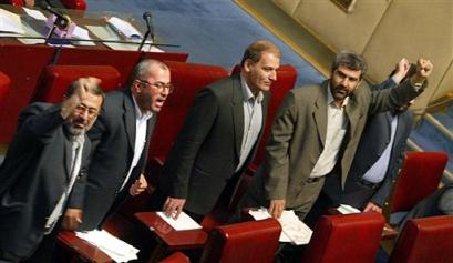
Nov. 1….(FOJ) With shouts of "Death to America," Iran's parliament unanimously approved the outline of a bill Sunday that would require the government to resume uranium enrichment, legislation likely to deepen an international dispute over Iran's nuclear activities. Still, Iran's top nuclear negotiator Hossein Mousavian told The Associated Press there was a 50 percent chance of a nuclear compromise with European nations. He ruled out an indefinite suspension of key enrichment activities, a concession that European negotiators have sought, but suggested Iran would consider calling a halt to building more nuclear facilities. The talks with the Europeans aim at averting a standoff over Iran's nuclear weapons program at a Nov. 25 meeting of the UN nuclear watchdog.  





|